
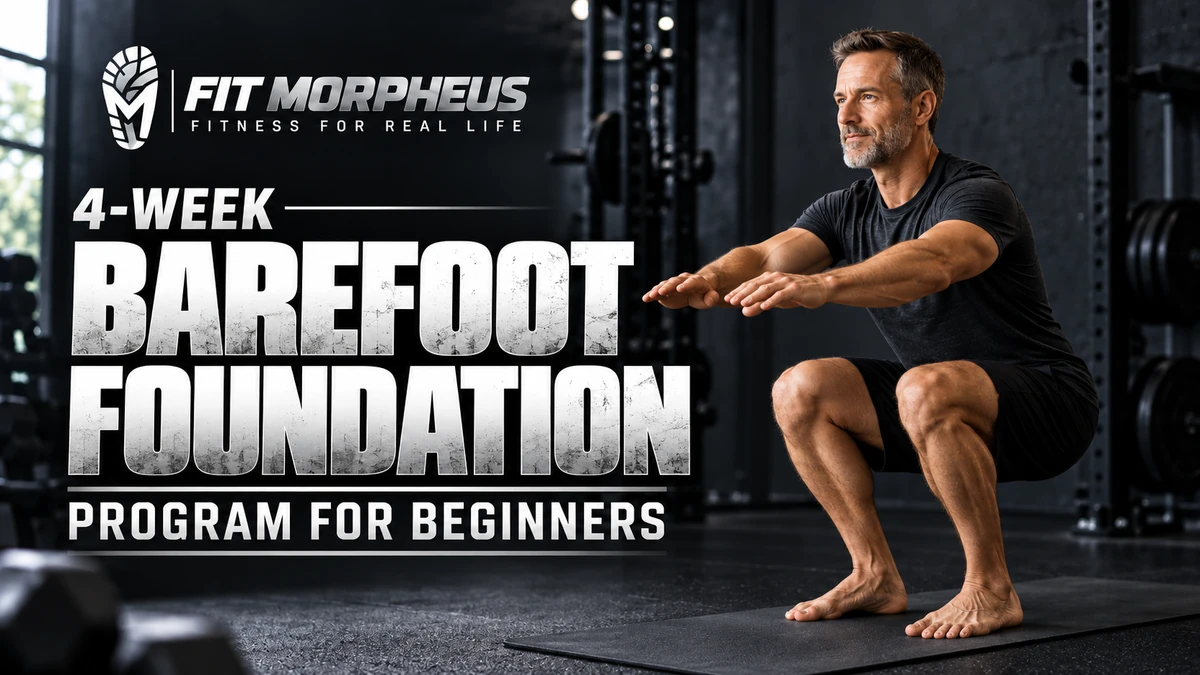
You do not need to run barefoot to start training your feet. This four-week plan begins with simple toe control and supported balance, then adds calf strength, squats, lunges and short walks as you become comfortable.
Three short sessions per week are enough to learn the movements. Each week builds on the previous one, with plenty of room to repeat a week if your feet or calves need more time. Keep the work easy enough that you can move well again at the next session.
What this program is for
This is a starting plan for adults who want to practice foot control, ankle strength, balance and basic lower-body movement. You can do the exercises on a clean, dry, nonslip indoor floor, near a stable countertop or chair. Barefoot is an option when it is safe and comfortable for you; supportive shoes are also fine for the balance and strength work.
Feel the floor
Spread the toes and notice pressure under the heel, base of the big toe and base of the little toe.
Stay steady
Practice supported single-leg balance, then carry that control into squats and lunges.
Build gradually
Progress calf raises, leg exercises and short walks only when the previous dose feels manageable.
Check footwear and foot health first. If you have diabetes with reduced sensation, a foot ulcer, poor circulation, or another condition that makes foot injury harder to notice, do not follow the barefoot portions of this plan without guidance from your clinician. The American Diabetes Association advises people with diabetes to avoid going barefoot, including at home. For a recent injury, persistent foot pain, or balance concerns, ask a qualified clinician which parts of the plan are appropriate.
How to use the plan
Train on Monday, Wednesday and Friday or Saturday. Leave at least a day between sessions. On other days, take a comfortable walk or rest. Each workout follows the same order: warm up, foot control, balance, lower-body strength, then an easy finish.
| Session part | What to do | Typical time |
|---|---|---|
| Warm up | Easy marching or walking; 8 ankle rocks per side | 2–3 min |
| Foot control | Toe spreads and tripod or short-foot holds | 2–4 min |
| Balance | Supported single-leg standing, then reach only when steady | 2–3 min |
| Strength | Calf raises plus the squat, bridge or lunge listed for the week | 4–8 min |
| Finish | Easy walk or gentle ankle movements | 1–2 min |
These times are planning estimates for this program, not measured clinical targets. Rest as needed.
For your starting position, stand comfortably with toes relaxed. Feel three broad contact areas: the heel, the base of the big toe and the base of the little toe. Keep the knee tracking comfortably over the foot. There is no need to force an arch shape or grip the floor with your toes.
The four-week barefoot foundation plan
Use this quick chart to see the progression. The doses below are example starting points. Move to the next week only if you can complete the current work with good control and no lingering increase in pain.
Toe control + supported balance
Short foot + calf raises
Reaches + lunges + carries
Steadier single-leg work + walks

Reconnect with your feet
Perform the following three times this week. Work near a stable support, and stop each set before your toes begin to claw or your balance becomes a struggle.
- Toe spreads: 1 set of 8 slow attempts per foot.
- Tripod foot holds: 5 holds of 5 seconds per foot.
- Supported single-leg balance: 2 holds of 15–20 seconds per side.
- Slow two-leg calf raises: 1 set of 8–10 repetitions.
- Bodyweight squats: 1 set of 6–8 comfortable repetitions, using a chair if helpful.
Strengthen the foot and ankle
Keep the same three-session schedule. Let your toes remain relaxed as you add gentle arch control and a little more calf work.
- Toe spreads: 1 set of 8–10 per foot.
- Short-foot holds: 2 sets of 5 holds of 5 seconds per foot.
- Supported single-leg balance: 2 holds of 20–25 seconds per side.
- Slow two-leg calf raises: 2 sets of 8–10 repetitions.
- Squats: 2 sets of 6–8 repetitions.
- Glute bridges: 1–2 sets of 8–10 repetitions.
Add movement without losing control
Combine the foot work with movement. Keep the reaches small, the loads light and your steps deliberate.
- Short-foot holds: 1 set of 5 per foot as a warm-up.
- Balance with a small reach: 2 rounds of 15–20 seconds per side near support.
- Calf raise progression: 2 sets of 8–10 two-leg raises, or 5–6 assisted single-leg raises per side if steady.
- Reverse lunges: 1–2 sets of 5–6 per side; hold a support.
- Squats: 2 sets of 8–10 repetitions.
- Farmer’s carries: 2 walks of 20–30 seconds with manageable weights, on a clear route. Shoes are fine.
Practice real-life capability
This is a practice week, not a test of how much you can lift. Choose the easier version whenever it keeps your movement smooth.
- Single-leg balance: 2 rounds of 20–30 seconds per side, supported as needed.
- Calf raises: 2 sets of 8–10 two-leg raises, or 5–8 supported single-leg raises per side.
- Split squats or reverse lunges: 2 sets of 6–8 per side.
- Squats: 2 sets of 8–10, with light added load only if you are steady.
- Farmer’s carries: 2 walks of 30–45 seconds with a manageable load.
- Optional barefoot walking: 5–10 easy minutes on a clean, safe indoor surface, once or twice this week. Use shoes instead if appropriate.
The progression rule
Change one thing at a time: a few repetitions, a little longer balance hold, a small amount of load, or a short increase in walking time. If a session leaves you limping, changes your normal gait, or produces pain that builds afterward, return to the previous comfortable dose and seek clinical advice for persistent symptoms.
How to do the exercises
Toe spreads
Stand or sit with the entire foot supported. Try to move the toes apart, then relax. Small movement counts. Keep the ankle quiet and avoid forcing the toes with your hands.
Tripod foot
Stand with even, comfortable pressure through the heel and the bases of the big and little toes. Let the arch respond naturally. Hold your position while breathing normally.
Short foot
While standing or sitting, gently draw the ball of the foot toward the heel without curling your toes. Imagine making the foot slightly shorter. Release fully between attempts.
Supported single-leg balance
Stand beside a stable countertop and lift one foot. Keep your hips level and use your fingertips as much as needed. To add a reach, extend one hand a short distance while staying close to the support.
Calf raises
With a hand on the counter, rise onto the balls of both feet, pause briefly and lower slowly. Only try the one-leg version when the two-leg version feels controlled.
Squats and split squats
For a squat, sit back and down toward a chair, then stand. Use a range you can control. For a split squat, take a short staggered stance, bend both knees slightly and rise again with support nearby.
Reverse lunges and carries
For a reverse lunge, step one foot back, lower only as far as comfortable, then return. For a carry, walk slowly with two light, evenly held objects and a clear path ahead. Choose shoes if the floor, load or footing calls for them.
Glute bridges
Lie on your back with knees bent and feet on the floor. Lift your hips until your trunk and thighs form a comfortable line; lower with control. Keep your feet planted without pressing your toes hard into the floor.
Keep it practical. Slight muscular effort is expected. Sharp pain, new swelling, numbness, or an altered walking pattern is a reason to stop and reassess. You can always repeat a week, shorten a session, or do the exercises in suitable footwear.
What to check after four weeks
You do not need a before-and-after photo or a soreness score. Compare a few everyday tasks from week one with how they feel now. Any improvement may be small, and four weeks is a starting point rather than a promised result.
| Check | Week 1 note | Week 4 note |
|---|---|---|
| Single-leg balance near a counter | Time, steadiness and support used | Repeat on the same surface |
| Slow calf raises | Comfortable reps with full control | Compare form before adding reps |
| Bodyweight squats | How the foot and ankle feel | Is pressure easier to manage? |
| Ordinary walking | Comfort and foot fatigue | Any useful change in confidence? |
After the program, keep two or three short sessions in your week, repeat the last week at a comfortable dose, or use this as a warm-up before your usual strength training. Barefoot walking and minimalist shoes are optional. If you choose to try them, increase exposure gradually and pay attention to the next day’s response.
Common questions
Do I need to be barefoot for every exercise?
No. Use the safest footwear for your floor, balance and health needs. You can practice toe movement and foot awareness while seated, then use comfortable shoes for standing work.
What if I cannot balance on one foot yet?
Keep one or both hands on a firm countertop, shorten the hold, or start with a staggered stance and both feet on the floor. Gradually reduce support only when you feel steady.
Should I start barefoot running in week four?
No. This plan ends with controlled strength work and, if appropriate, a short easy walk. Running and jumping place different demands on the feet and calves and need a separate progression.
What if my feet are sore the next day?
Reduce the next session’s volume or repeat the previous week. If pain is sharp, worsening, or affecting how you walk, stop the activity and seek professional advice.
Keep building from the ground up
The useful habit is simple: practice foot control, build the calves and legs, and bring that steadiness into the movements you do every day. For a broader look at foot strength and footwear, start with the related Fit Morpheus guides below.
Sources and further reading
This is a general fitness plan for beginners, not an injury treatment. The session layout and weekly progression are Fit Morpheus programming choices. These references inform the exercise selection and safety notes:
- American Academy of Orthopaedic Surgeons: Foot and Ankle Conditioning Program — calf raises, ankle movement and supported single-leg balance.
- Cambridge University Hospitals: General Stability Exercises — single-leg standing, heel raises and bridges.
- Ridge et al.: Walking in Minimalist Shoes Is Effective for Strengthening Foot Muscles — an eight-week study of foot-muscle changes; it does not establish guaranteed outcomes for this four-week plan.
- American Diabetes Association: Diabetes & Your Feet — why people with diabetes should protect their feet and avoid going barefoot.