Fit Morpheus · Nutrition & Body Composition
Can you eat food and still experience some of the metabolic responses associated with fasting?
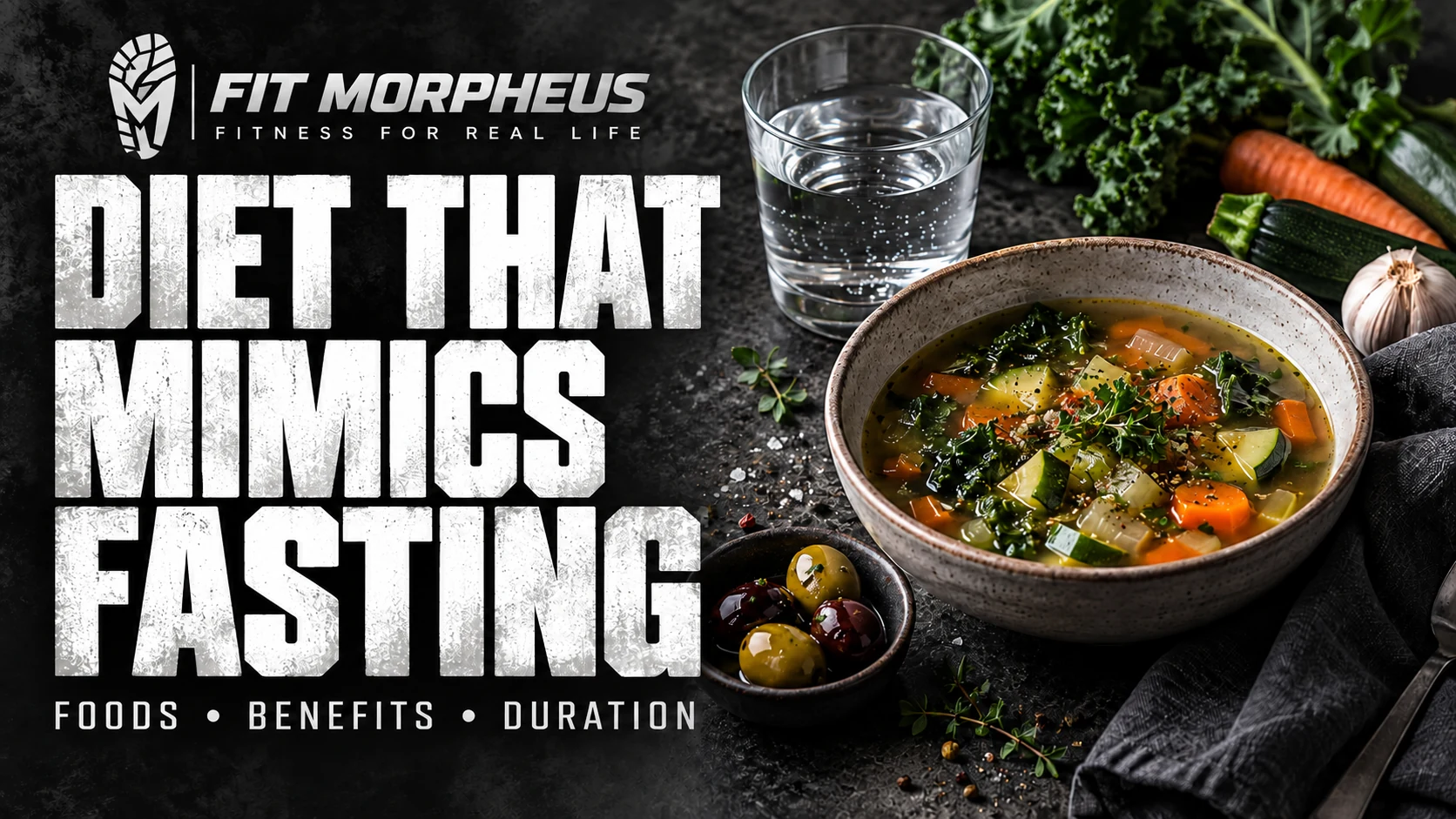
That is the idea behind a diet that mimics fasting: a short, carefully structured eating program designed to produce fasting-like effects while allowing limited food.
Affiliate disclosure: This article contains an Amazon affiliate link. As an Amazon Associate, I earn from qualifying purchases.
Fasting gets attention for weight management, metabolic health, and healthy aging. But going without food for several days is a demanding approach with real risks.
A fasting-mimicking diet takes a different route. You eat a restricted amount of selected foods for a brief period, then return to regular eating.
You may hear it called a “mimic fast,” “fasting with food,” or a fasting-mimicking diet, abbreviated FMD. The concept is promising, but understanding the details matters more than the marketing language.
What Is Fasting?
In nutrition, fasting generally means going without food or calorie-containing drinks for a defined period. Different approaches vary in duration and in what they permit.
During a period without food, your body continues to need energy. It draws on stored fuels, including liver glycogen and fat. As fasting continues, ketone production can increase.
These changes happen gradually. There is no universal hour when everyone enters ketosis or receives a particular health benefit.
Common Fasting Durations and Approaches
A daily eating window and a multi-day fast are different interventions. Their demands, risks, and supporting evidence should be considered separately.
| Approach | Typical structure | Important distinction |
|---|---|---|
| Overnight fasting | A gap between the evening meal and breakfast, often around 12 hours. | Does not necessarily involve substantial calorie restriction. |
| Time-restricted eating | Food is consumed within a daily window, such as 8–10 hours. | Focuses on timing; food quality and total intake still matter. |
| Alternate-day or 5:2 approaches | Regular eating days alternate with fasting or markedly reduced intake days. | Some versions allow food on restricted days. |
| Multi-day water-only fasting | No food for multiple days. | Carries greater risks and should not be treated as a routine DIY challenge. |
| Fasting-mimicking diet | A brief, structured low-calorie program; commonly five days. | Allows selected foods and aims to reproduce some fasting-like responses. |
These durations describe common approaches, not a recommendation to work toward longer fasts. Longer is not automatically better.
What Is a Diet That Mimics Fasting?
A fasting-mimicking diet is a short-term eating program that restricts calories and carefully controls nutrient composition. Studied versions have generally been plant-based and low in protein.
The intention is to influence energy availability and nutrient-sensing pathways in ways that resemble aspects of fasting, while still providing food.
This makes the approach different from simply skipping breakfast, eating a ketogenic diet, or having soup whenever you feel hungry. The overall formulation, portions, duration, and return to regular eating are part of the intervention.
Fasting-like does not mean identical
A diet that mimics fasting may reproduce some metabolic responses. That does not establish that it produces every effect of a water-only fast, or that any homemade low-calorie menu will reproduce clinical trial results.
Can You Eat and Stay in Ketosis?
Yes, it is possible to eat and remain in nutritional ketosis. Ketone production depends on the overall metabolic situation, including carbohydrate availability, energy intake, activity, and individual differences.
Some fasting-mimicking interventions have increased circulating ketones in human research. However, entering or remaining in ketosis is not guaranteed for every participant.
More importantly, ketosis is only one response. A ketone reading cannot tell you whether a diet has produced the same changes in nutrient signaling, cellular processes, or long-term health outcomes as a studied fasting protocol.
Adding butter, oil, protein drinks, or extra snacks may leave someone in ketosis while changing the intended fasting-mimicking intervention. “It does not knock me out of ketosis” is not sufficient evidence that an addition fits the program.
What Foods Are Used in a Mimic Fast?
Foods associated with fasting-mimicking programs include portioned vegetable soups, selected plant foods, small servings of fats, and specifically formulated snacks or drinks.
Broth can be part of some modified fasting approaches, but broths vary considerably. Vegetable broth may contain little energy, while bone broth can provide meaningful amounts of protein.
| Food or drink | What to understand |
|---|---|
| Vegetable soups | Ingredients, portions, oils, starches, and protein determine how they fit a specific protocol. |
| Broths | Check calories, protein, and sodium. Different broths are not nutritionally interchangeable. |
| Olives, nuts, and other fats | Small servings may appear in formulated programs, but these foods can add substantial calories. |
| Bars and crackers | A program-specific product is not automatically interchangeable with a regular snack or protein bar. |
| Water and unsweetened herbal tea | Often included, but follow the program’s instructions and any medical guidance on fluids. |
These are examples, not a complete five-day meal plan. A list of low-calorie foods does not establish a nutritionally appropriate or clinically equivalent fasting-mimicking diet.
Potential Benefits: What Human Research Shows
Body weight and selected metabolic markers
A 2017 randomized trial studied three monthly cycles of a five-day fasting-mimicking diet. Researchers reported reductions in body weight and selected cardiometabolic risk factors. Some improvements were greater in participants who started with elevated risk markers.
These findings support further investigation. They do not establish that everyone needs an FMD, that it is superior to every sustainable eating approach, or that it prevents diseases named in a study title.
Insulin resistance, liver fat, and aging-related markers
A 2024 study reported secondary and exploratory analyses linking repeated FMD cycles with improvements in insulin resistance, liver fat, and certain aging-related markers.
The reported change in estimated biological age was based on a biomarker model. It does not mean participants literally became younger, and it does not prove that the diet extends human lifespan.
Autophagy and cellular recycling
Autophagy is a normal cellular process involved in breaking down and recycling cellular components. It is often described online as a switch that turns on after a specific fasting hour, but that description is too simple.
A small pilot randomized trial published in 2025 examined fasting-mimicking diets in 30 adults. Researchers found changes consistent with increased autophagic flux in blood immune cells at certain measured points.
The results are preliminary. They do not demonstrate a whole-body “reset,” establish an exact autophagy timeline, or prove a long-term clinical benefit.
Research context: several prominent FMD studies disclose commercial relationships with L-Nutra, the company behind ProLon. The autophagy pilot was company-sponsored. These disclosures should be considered alongside study size, design, and limitations.
How Long Does a Fasting-Mimicking Diet Last?
The best-known commercial format lasts five consecutive days, followed by a transition back to regular eating.
Several clinical studies have used repeated cycles separated by weeks of usual eating. For example, some trials tested one five-day cycle per month.
That describes a research schedule, not a universal recommendation. How often to repeat a cycle depends on suitability, health status, and professional guidance.
A fasting-mimicking diet is a periodic intervention. Its low-calorie, low-protein phase is not intended to become your everyday diet.
ProLon: A Structured Option With Pre-Portioned Foods
For people who prefer a packaged approach instead of assembling a homemade menu, ProLon offers a five-day fasting-mimicking program with pre-portioned foods and daily instructions.
ProLon formulations have been used in human research. That connection applies to the studied programs and outcomes; it should not be interpreted as proof of every marketing claim or every product sold under the brand.
Depending on the version, the program includes soups, bars, snacks such as olives or crackers, beverages, and supplements. The manufacturer currently describes approximately 1,100 calories on day one and 700–800 calories on days two through five.
Those figures describe the product, not a calorie prescription for a homemade plan. Follow the instructions supplied with the exact kit rather than replacing items based only on calorie totals.
Explore ProLon on Amazon
Prefer pre-portioned foods and a defined five-day structure? Use the link below to browse the ProLon store and compare the available programs.
Browse ProLon on Amazon →Affiliate link. Check the listing for the exact kit, ingredients, seller, instructions, and current price. Individual bars or other standalone products are not automatically a complete five-day program.
Who Should Avoid Fasting or Get Medical Guidance?
Eating some food does not remove the risks of substantial calorie restriction. Before a multi-day FMD, discuss suitability with a healthcare professional.
ProLon’s published guidance advises against fasting use during pregnancy or breastfeeding, when underweight, with an eating disorder, or during active infection. It also specifies professional supervision for people under 18 or over 70.
Anyone with a medical condition or taking prescription medication should obtain individualized guidance. Diabetes requires particular care: fasting can interact with glucose-lowering medication and increase risks such as hypoglycemia.
Check ingredient labels for allergies and dietary restrictions. Do not stop or adjust prescribed medication to fit a fasting program without your clinician’s direction.
Training, Physical Work, and Returning to Regular Food
A five-day period of markedly reduced intake may affect energy, concentration, and exercise tolerance. Plan around demanding workouts and physically strenuous work, and follow the program’s activity guidance.
Stop the program and seek medical advice if you develop significant dizziness, persistent vomiting, or unusual weakness. Fainting, confusion, chest pain, or a severe allergic reaction require urgent medical attention.
After the program, follow its transition instructions. Avoid celebrating completion with an unusually large meal. Return to adequate, balanced nutrition, including sufficient protein to support your usual activity and recovery.
People who are malnourished or have had prolonged minimal intake need medical guidance when restarting food because of refeeding risks.
Frequently Asked Questions
Does broth break a fast?
Calorie-containing broth breaks a strict zero-calorie fast. It may be permitted in a particular modified fasting program. That does not make it equivalent to water-only fasting.
Can I stay in ketosis while eating?
Yes. However, ketosis does not confirm that you are reproducing every fasting-related response or the outcomes of a studied fasting-mimicking diet.
Is a fasting-mimicking diet the same as keto?
No. Ketogenic diets primarily restrict carbohydrate. Fasting-mimicking diets also use a defined period of calorie restriction and controlled nutrient composition, commonly including low protein.
Can I make my own diet that mimics fasting?
You can assemble a low-calorie menu, but that does not establish equivalence to a studied formulation. A registered dietitian or clinician can help assess whether an appropriate plan makes sense for you.
Will the weight I lose all be body fat?
No. Short-term scale changes can include water, glycogen, and digestive contents as well as changes in body tissue. Weight can rise when regular eating resumes without representing equivalent fat gain.
Is ProLon necessary for good health?
No. It is one structured approach. Consistent nutrition, strength training, everyday movement, sleep, and appropriate medical care remain the foundation.
Choosing an Approach That Fits Your Life
A diet that mimics fasting offers an interesting middle ground: limited food within a structured program designed to produce some fasting-like responses.
If you are considering it, first establish whether it is appropriate for your health and workload. Then compare the actual protocol, evidence, ingredients, and practical demands.
The habits you return to after those five days deserve at least as much attention as the program itself.
Sources and Further Reading
- Wei M and colleagues. Fasting-mimicking diet and markers/risk factors for aging, diabetes, cancer, and cardiovascular disease . Science Translational Medicine, 2017.
- Brandhorst S and colleagues. Fasting-mimicking diet causes hepatic and blood markers changes indicating reduced biological age and disease risk . Nature Communications, 2024.
- Espinoza SE and colleagues. Effect of fasting-mimicking diet on markers of autophagy and metabolic health in human subjects . GeroScience, published online in 2025.
- National Institute of Diabetes and Digestive and Kidney Diseases. Fasting safely with diabetes .
- ProLon. Five-day program details and manufacturer health and safety guidance .
This article provides general education, not an individualized fasting or medical treatment plan.
Leave a Reply