Balance is one of those physical abilities most people ignore until they notice they’re losing it.
Strength gets attention.
Cardio gets attention.
Mobility gets attention.
But balance?
For many adults, it doesn’t become a priority until standing on one leg feels harder than expected, uneven ground becomes uncomfortable, or a stumble reminds them how quickly the body sometimes needs to react.
That’s backward.
Balance is something worth training before you think you need it.
At Fit Morpheus, fitness is about maintaining physical options.
Can you hike?
Climb stairs?
Step over something?
Carry a heavy object?
Walk over uneven ground?
Catch yourself when you misstep?
Those activities require more than strong muscles. They require your brain, eyes, inner ear, feet, joints, and muscles to work together.
That’s balance.
And like strength, balance can be trained.
What Is Balance?
Balance is your ability to control your body’s position relative to the environment around you.
Your nervous system constantly combines information from several sources:
- Vision — tells you where you are relative to your surroundings.
- Vestibular system — structures in the inner ear help detect movement and changes in head position.
- Proprioception — sensory information from muscles, joints, and tissues helps tell your brain where your body is in space.
- Muscular control — your muscles make constant small corrections to keep you upright.
Most of this happens without you consciously thinking about it.
Until the system is challenged.
Balance Is Not Just for Older Adults
Balance often gets treated like a fall-prevention topic for elderly people.
It certainly becomes more important later in life, but balance matters long before then.
You use it when you:
- Walk
- Run
- Hike
- Climb stairs
- Step off a curb
- Lift weights
- Carry groceries
- Stand on a ladder
- Paddle
- Ski or snowboard
- Move across uneven terrain
- Get dressed while standing
For adults 65 and older, U.S. physical-activity guidelines specifically recommend activities that improve balance along with aerobic activity and muscle strengthening.
The better strategy is not waiting until 65 to start.
If you’re in your 40s or 50s, you’re in an excellent position to build and maintain these abilities now.
Balance Is a Trainable Skill
Balance isn’t something you’re simply born good or bad at.
It responds to practice.
Repeated balance training can improve both static and dynamic balance.
Static Balance
Maintaining control while relatively stationary.
Examples:
- Standing on one leg
- Holding a split stance
- Maintaining a controlled position
Dynamic Balance
Maintaining control while moving.
Examples:
- Walking over uneven terrain
- Lunging
- Stepping onto a box
- Changing direction
- Hiking
- Using a balance board
Both matter.
And because balance is somewhat task-specific, you shouldn’t build your entire program around one exercise.
Standing on one leg is useful.
But real life also requires stepping, reaching, carrying, turning, and responding to changing surfaces.
Start With a Simple Balance Test
Stand near a wall or sturdy counter.
If you’re comfortable doing so, take your shoes off.
Lift one foot slightly from the ground.
Hold the position.
Notice what happens.
Does your:
- Ankle wobble?
- Foot roll inward or outward?
- Hip shift?
- Big toe lift?
- Upper body sway?
- Foot start gripping aggressively?
Now switch sides.
You’re not assigning yourself a grade.
You’re simply identifying a starting point.
Your Feet Are Part of the Balance System
Your feet are where your body meets the ground.
They provide both force and sensory information.
Your toes help interact with the surface beneath you.
Your ankles make constant small corrections.
Your lower legs and hips respond above them.
This is why balance fits naturally with barefoot training and foot health.
One useful concept is the foot tripod.
Think about three contact areas:
- Heel
- Base of the big toe
- Base of the little toe
Stand barefoot and feel those three points.
Then try standing on one leg without aggressively curling your toes.
You’re teaching your foot to contribute to stability instead of simply gripping the floor.
Ankle and Leg Strength Matter Too
Balance doesn’t exist separately from strength.
When you stumble, your body needs enough strength to correct the movement.
Useful exercises include:
- Calf raises
- Single-leg calf raises
- Split squats
- Step-ups
- Lunges
- Single-leg deadlifts
These build strength while also challenging balance and coordination.
That’s more functional than treating balance as a completely separate type of training.
Five Simple Balance Exercises
You don’t need special equipment to begin.
1. Single-Leg Stand
Stand near support.
Lift one foot.
Hold for:
20–30 seconds per side
Repeat two or three times.
Once this becomes easy, progress the exercise rather than simply increasing the time forever.
2. Heel-to-Toe Walking
Walk in a straight line.
Place the heel of the front foot close to the toes of the rear foot.
Move slowly and deliberately.
This narrows your base of support and makes normal walking more challenging.
3. Split Squat
Stand with one foot forward and one behind.
Lower under control.
Stand back up.
Perform:
2–3 sets of 8–12 repetitions per side
This builds leg strength, hip control, ankle control, and balance simultaneously.
4. Step-Ups
Place one foot on a stable step.
Drive through that leg and stand up.
Lower slowly.
Step-ups translate well to:
- Stairs
- Hiking
- Curbs
- Climbing
5. Single-Leg Romanian Deadlift
Stand on one leg.
Push your hips backward as the opposite leg extends behind you.
Return to standing.
Start without weight.
Eventually add a dumbbell or kettlebell.
This challenges the foot, ankle, hip, hamstrings, and coordination all at once.
Loaded Carries Are Balance Training Too
Loaded carries don’t look like traditional balance training.
That’s one reason they’re so useful.
Hold something heavy and walk.
Your body continuously has to control the load.
Farmer’s Carry
Weight in both hands.
Suitcase Carry
Weight in one hand.
The suitcase carry is particularly useful because an uneven load tries to pull you sideways.
Your trunk, hips, legs, and feet have to resist that movement while you walk.
That’s balance under load.
And it looks a lot like real life.
Uneven Terrain Builds Dynamic Balance
Perfect gym floors are predictable.
Trails aren’t.
Hiking exposes you to:
- Rocks
- Roots
- Slopes
- Loose surfaces
- Uneven steps
Your body constantly adapts.
This is one reason hiking is such a good lifestyle-fitness activity.
If you want to prepare for uneven terrain, train:
- Step-ups
- Split squats
- Calf raises
- Single-leg balance
- Loaded carries
- Walking on varied surfaces
Then go hike.
Progress Balance Gradually
Balance training should progress just like strength training.
Start with:
Stable ground
Then add:
- Single-leg positions
- Reaching
- Head movement
- Light loads
- Stepping
- Uneven surfaces
- Controlled unstable surfaces
You don’t need to immediately jump onto the most difficult balance device available.
Difficulty isn’t the goal.
Control is.
When a Balance Board Makes Sense
Once basic balance tasks become manageable, a balance board can provide another level of challenge.
A board changes the surface beneath you, forcing constant corrections from the:
- Feet
- Ankles
- Legs
- Hips
- Trunk
Balance-board work can be a useful supplement to normal strength and movement training.
The key word is:
Supplement.
A balance board should not replace:
- Squats
- Hinges
- Lunges
- Step-ups
- Carries
- Walking
- Strength training
You want both.
A Balance Board I Use for More Advanced Training
Affiliate Disclosure: Fit Morpheus may earn a commission from qualifying purchases made through links in this section, at no additional cost to you.
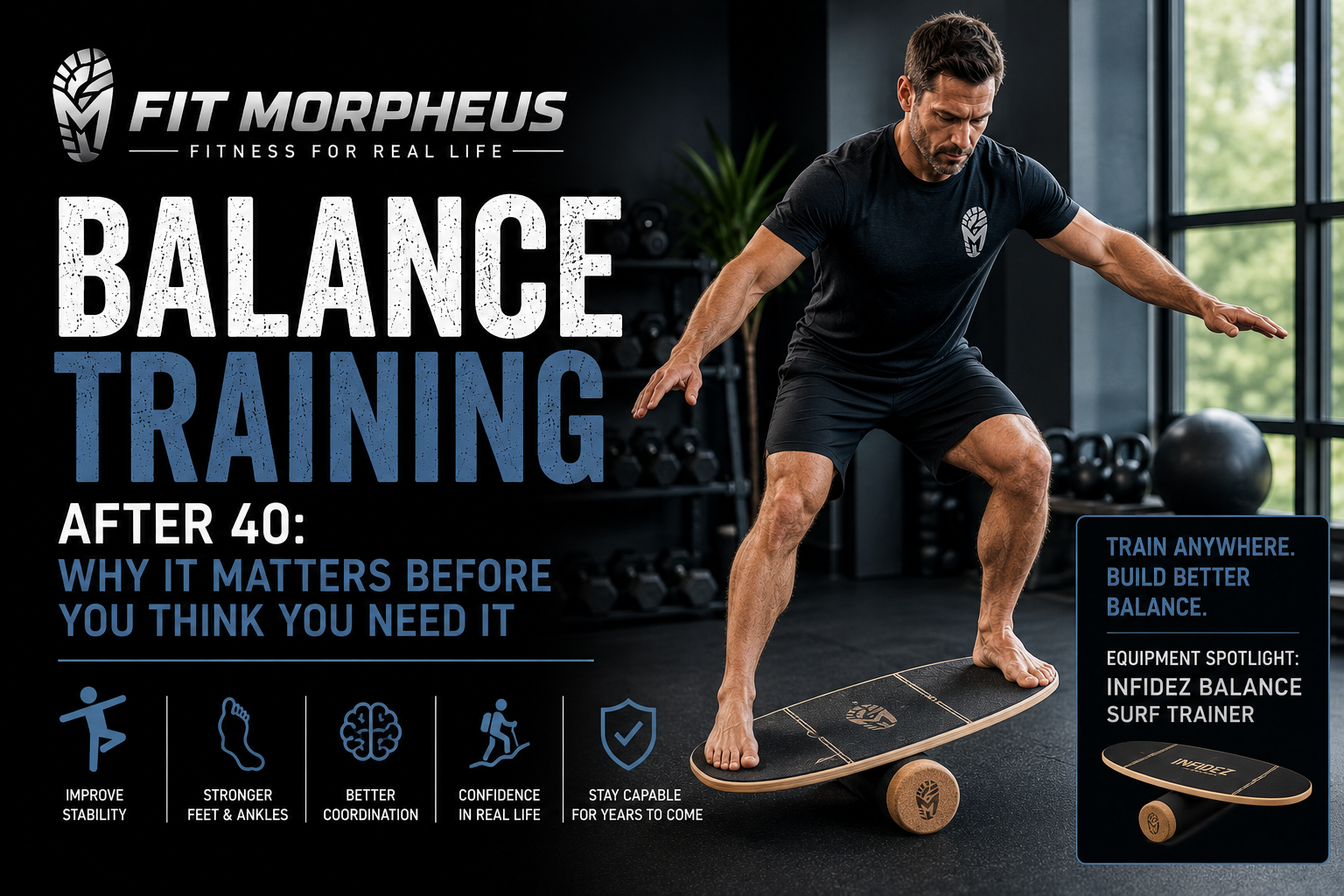
One option for progressing beyond basic floor-based balance exercises is the INFIDEZ Balance Surf Trainer.

What makes this style of board useful is that it can provide different levels and types of instability instead of one fixed challenge.
The product is designed for uses including:
- Rocker-board training
- Dynamic balance work
- Surf-style roller training
- Snowboard and board-sport practice
The linked model includes an anti-slip board surface and cork roller.
That makes it particularly interesting for people who enjoy:
- Surfing
- Paddleboarding
- Snowboarding
- Skateboarding
- Wakeboarding
But you don’t need to participate in a board sport to use one.
It can also challenge general:
- Foot control
- Ankle stability
- Coordination
- Dynamic balance
- Trunk control
Why I Prefer a Multi-Mode Balance Trainer
Balance is specific.
Once your body learns one task, that exact task becomes easier.
A multi-mode board gives you more than one type of challenge.
A simpler rocker setup can provide relatively predictable side-to-side movement.
A more advanced configuration increases the coordination demand.
The roller setup creates a much more dynamic challenge.
That means one piece of equipment can progress with you.
But don’t assume the hardest setup is automatically the most useful.
Use the level you can control.
How to Start With a Balance Board
Put the board near:
- A wall
- Counter
- Stable rail
Give yourself space.
Avoid practicing beside:
- Sharp furniture
- Loose weights
- Glass
- Other obstacles
Then progress gradually.
Stage 1: Supported Standing
Keep both hands near support.
Learn how the board moves.
Stage 2: Light Support
Use your fingertips only when needed.
Stage 3: Independent Standing
Balance without touching support.
Stage 4: Controlled Movement
Add:
- Small knee bends
- Weight shifts
- Reaching
Stage 5: More Difficult Configuration
Only after the earlier stages feel controlled.
You don’t earn extra progress by falling off a more difficult setting.
What Not to Do
Don’t turn every normal strength exercise into an unstable-surface exercise.
You may see people attempting:
- Heavy squats on balance boards
- Heavy presses on unstable surfaces
- Complicated combinations while barely staying upright
Difficulty does not automatically equal effectiveness.
If your goal is strength:
Train strength on stable ground.
If your goal is balance:
Train balance.
Use the tool that matches the objective.
A Five-Minute Balance Routine
You don’t need a separate balance day.
Try this two or three times per week.
Single-Leg Stand
30 seconds per side.
Single-Leg Calf Raise
10 repetitions per side.
Split Squat
8 repetitions per side.
Single-Leg Romanian Deadlift
5 controlled repetitions per side.
Balance Board Practice
30–60 seconds.
Repeat for:
2 rounds
That is enough to add meaningful balance training without taking over your entire workout.
Balance Training After 40
Your 40s are not old age.
They’re an opportunity to prepare for it.
Instead of waiting until 70 to think about:
- Balance
- Strength
- Mobility
- Bone health
- Cardiovascular fitness
build those qualities now.
Imagine yourself decades from today.
You misstep off a curb.
Would you rather have years of:
- Strength training
- Walking
- Foot training
- Hiking
- Balance work
behind you?
No balance program guarantees you’ll never fall.
That’s not realistic.
The purpose is improving your body’s ability to respond when the environment doesn’t cooperate.
Balance and Independence
Ultimately, balance is about physical freedom.
Being able to:
- Walk confidently
- Navigate stairs
- Carry things
- Hike
- Travel
- Move through unfamiliar environments
- Get onto and off the floor
helps preserve independence.
That’s a much better reason to train balance than simply becoming good at standing on one leg.
Common Balance Training Mistakes
Starting Too Advanced
Master stable ground first.
Ignoring Strength
Strong legs give you more ability to recover from instability.
Ignoring Your Feet
Your feet are the interface between your body and the ground.
Only Standing Still
Real life requires dynamic balance.
Step.
Lunge.
Carry.
Walk.
Making Every Exercise Unstable
Strength training should still allow you to develop strength.
Waiting Until Balance Becomes a Problem
Train it now.
The Fit Morpheus Balance Approach
Keep it simple.
Train your feet.
Strengthen your legs.
Use single-leg exercises.
Carry things.
Walk over different surfaces.
Practice dynamic movement.
Add unstable surfaces gradually.
Keep strength training.
And think long term.
You aren’t training so you can become an expert at balancing on a board.
You’re training so your body can adapt when life moves underneath you.
Fit Morpheus
Balance isn’t something to start training when you begin losing it. It’s something worth keeping before it becomes a limitation.
Build strength.
Control your movement.
Train your foundation.
Stay capable.
Fitness for real life.
Recommended Balance Trainer
INFIDEZ Balance Surf Trainer — Advanced Balance Board, Rocker Board & Surf Trainer
The Product is Available on Amazon. Click Here to find out more!
I KEEP ONE AT THE OFFICE AND ONE AT HOME
Use a stable support when learning and progress only as your control improves.
Affiliate Disclosure: Fit Morpheus may earn commissions from qualifying purchases made through affiliate links in this article. As an Amazon Associate I earn from qualifying purchases.
Educational Disclaimer: This article provides general fitness education and is not individualized medical or rehabilitation advice. People with a history of falls, unexplained dizziness, significant balance impairment, recent surgery, or neurological conditions should consult an appropriate healthcare professional before beginning challenging balance training.