Most fitness programs start above the ankles.
People train their:
- Legs
- Glutes
- Core
- Back
- Chest
- Shoulders
- Arms
They work on cardio.
They track calories.
They improve mobility.
But underneath nearly every standing exercise and every step you take are two structures that rarely receive the same attention:
Your feet.
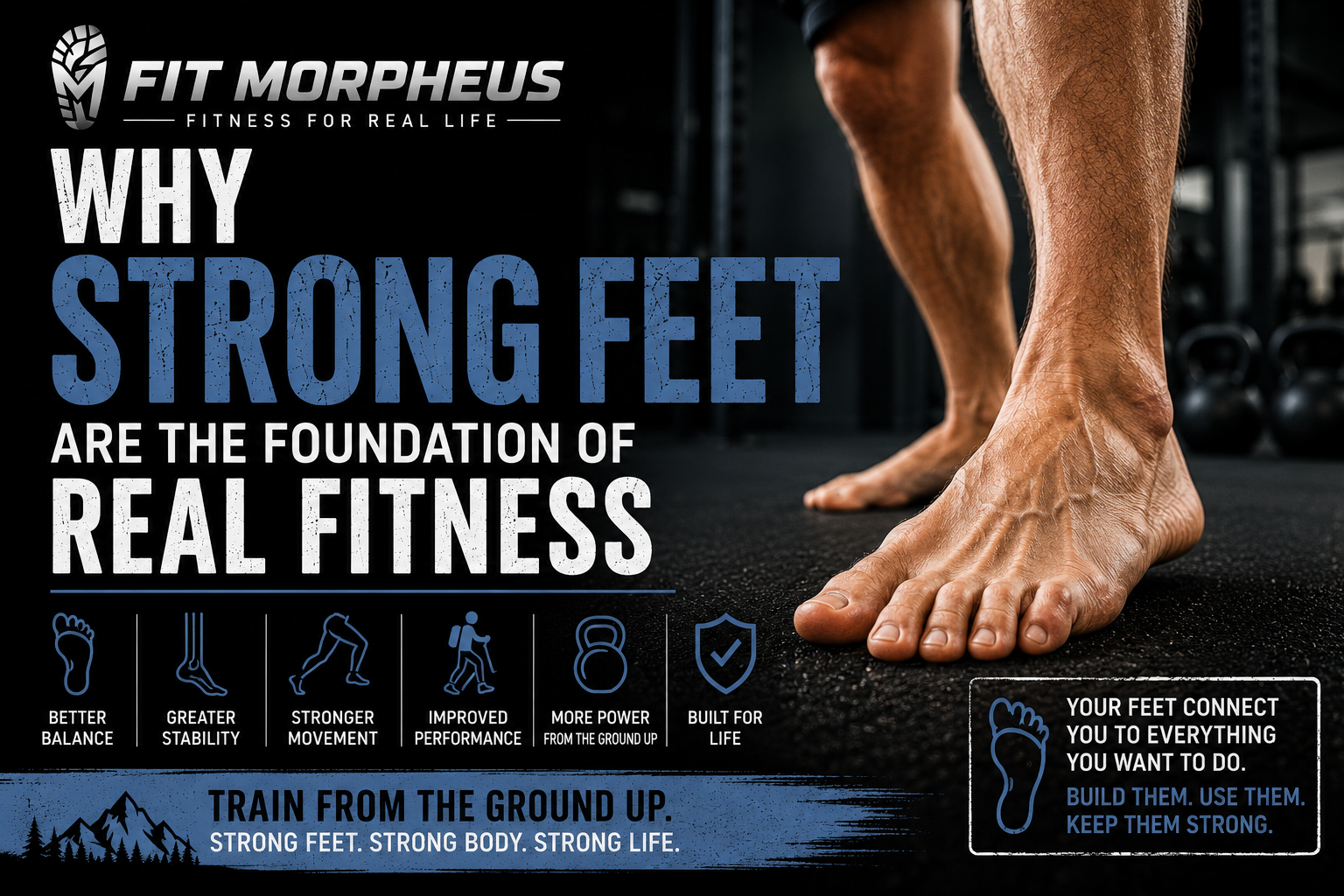
Your feet are the connection between your body and the ground.
They help you stand.
Walk.
Balance.
Squat.
Hinge.
Carry.
Climb.
Run.
Hike.
React when the surface underneath you changes.
That doesn’t mean every physical problem starts in your feet, and strong feet aren’t a cure for every knee, hip, or back issue.
But ignoring your feet while trying to build a capable body doesn’t make much sense either.
At Fit Morpheus, the goal isn’t simply to build stronger muscles.
It’s to build a body that works together.
And that process starts from the ground up.
Your Feet Are More Than Something You Stand On
The foot isn’t a rigid block attached to the bottom of your leg.
Each foot contains a complex combination of:
- Bones
- Joints
- Muscles
- Tendons
- Ligaments
- Nerves
These structures work together to help your foot adapt to the surface beneath you while also creating a stable platform for movement.
Some muscles that control the foot begin in the lower leg.
Others are located entirely inside the foot itself.
These intrinsic foot muscles contribute to functions such as:
- Toe control
- Arch support
- Balance
- Stability
- Force transfer
Like other muscles in the body, they can respond to training.
Research examining intrinsic foot-muscle exercise has found improvements in measures including foot strength, balance, and aspects of foot function.
That’s enough reason to stop treating the feet as passive structures.
Real Fitness Starts With Contact With the Ground
Think about a squat.
You may be focused on your:
- Quadriceps
- Glutes
- Hips
- Core
But where does the movement begin?
At the floor.
The force your legs create has to travel through your feet into the ground.
The same is true during:
- Deadlifts
- Lunges
- Step-ups
- Farmer’s carries
- Hiking
- Running
- Jumping
Your feet are part of the foundation that allows the rest of the body to create and control force.
A stronger foundation doesn’t automatically make every movement perfect.
But a foundation that can adapt, stabilize, and transmit force gives the rest of your body something useful to work from.
Strong Feet Help Create a Stable Base
Try standing barefoot.
Feel the ground beneath you.
Now shift all your weight toward your heels.
Then toward your toes.
Then toward the inside edge of your feet.
Then outside.
Notice how much your body above the foot has to adjust.
Your foot position influences what happens farther up the chain.
That doesn’t mean there’s one perfect position everyone must maintain.
It means your body constantly reacts to the information coming from the ground.
A capable foot should be able to create stability without becoming rigid.
Learn the Foot Tripod
One of the simplest concepts in foot training is the foot tripod.
Imagine three general contact points:
- Heel
- Base of the big toe
- Base of the little toe
Stand barefoot and feel those three areas.
Don’t drive them into the floor as hard as possible.
Just maintain contact.
Now perform a slow squat.
Can you keep the foot connected to the ground without:
- Rolling heavily inward
- Rolling heavily outward
- Lifting the heel
- Gripping aggressively with the toes
This isn’t about creating a flawless squat.
It’s about developing awareness.
Before you can control your feet better, you first have to notice what they’re doing.
Toe Strength Matters
Your toes aren’t decorative.
They contribute to interacting with the ground during:
- Standing
- Walking
- Balance
- Push-off
- Direction changes
Many adults discover they have surprisingly little conscious control over their toes.
Try this.
Keep your foot flat.
Lift only your big toe.
Now put it down.
Keep the big toe down and lift the other four.
Easy?
For some people.
Nearly impossible for others.
That doesn’t automatically mean something is wrong.
It simply demonstrates that foot control can be trained just like other movement skills.
Toe Spread Matters Too
A foot with enough room for the toes to move has more options for interacting with the ground.
Try spreading your toes while standing barefoot.
Don’t force them.
Don’t curl them.
Simply try to increase the space between them.
This can be surprisingly difficult if you’ve spent years wearing narrow footwear.
Toe-spread work isn’t going to transform your fitness by itself.
But it’s one simple way to restore awareness and control to an area most people rarely train.
Your Feet Play a Major Role in Balance
Balance depends on much more than your feet.
Your visual system, inner ear, nervous system, muscles, joints, and brain all contribute.
But your feet are where that system contacts the ground.
Your foot constantly receives information about pressure and surface changes.
Your ankle responds.
Your leg responds.
Your hips and trunk respond.
This is why simple barefoot balance work can be so revealing.
Stand on one foot.
You may feel:
- Toes adjusting
- Arch changing
- Ankle wobbling
- Calf working
- Hip correcting your position
Those small movements aren’t necessarily a problem.
They’re your body solving the balance task.
Foot training can therefore fit naturally into a broader balance program.
Strong Feet Need Strong Ankles and Calves
Foot training shouldn’t stop at the foot.
Your foot, ankle, and lower leg function together.
The calves contribute to:
- Walking
- Hiking
- Running
- Climbing stairs
- Jumping
- Balance
If you’re interested in building stronger feet, one of the best exercises available is also one of the simplest:
Calf Raises
Stand tall.
Rise onto the balls of your feet.
Pause.
Lower slowly.
Start with:
2–3 sets of 10–15 repetitions
As you get stronger, progress toward:
- Single-leg calf raises
- Weighted calf raises
- Larger comfortable ranges of motion
Simple strength matters.
Ankle Mobility Is Part of the Foundation
Your ankles need enough motion to support the activities you’re asking them to perform.
Ankle dorsiflexion—the ability for the knee to move forward over the foot—plays an important role in:
- Squatting
- Lunging
- Walking
- Descending stairs
- Hiking downhill
If the ankle is significantly restricted, your body may compensate elsewhere.
That doesn’t mean every squat problem comes from poor ankle mobility.
But the ankle deserves consideration.
A simple drill:
Keep your heel down.
Move your knee forward over your foot.
Return.
Perform:
10–15 controlled repetitions per side.
No aggressive stretching required.
Barefoot Training Can Help You Feel Your Foundation
Barefoot training doesn’t magically fix the body.
But removing shoes during appropriate exercises changes the interaction between your feet and the ground.
Without a thick sole, you may notice:
- Where your weight sits
- Whether your toes are gripping
- How your arch responds
- How your ankle moves
- Differences between sides
That feedback can make barefoot training useful for:
- Balance drills
- Bodyweight squats
- Mobility exercises
- Calf raises
- Light strength training
- Loaded carries
But barefoot training is a tool.
Not a religion.
Minimalist Shoes Can Provide a Middle Ground
You don’t have to choose between thick conventional footwear and being completely barefoot.
Minimalist footwear can provide protection while allowing more foot movement.
Common characteristics include:
- Wider toe box
- Flexible sole
- Lower heel-to-toe drop
- Less cushioning
- Less structural support
Research has found that gradual exposure to minimalist footwear can increase some measures of foot-muscle strength.
But the word gradual matters.
If you’ve worn supportive or cushioned footwear for decades, your feet and lower legs may not be prepared for a sudden change.
Don’t Transition Too Quickly
This may be the biggest barefoot-training mistake.
Someone becomes excited about foot strength.
They buy minimalist shoes.
Then immediately:
- Wear them all day
- Walk several miles
- Run in them
- Lift in them
Their feet and calves suddenly receive far more work than they’re accustomed to.
Then everything hurts.
The problem isn’t necessarily minimalist footwear.
The problem may be the size of the training change.
Treat new footwear like any other new training stimulus.
Start small.
Adapt.
Progress.
Walking Barefoot Is Training Too
You don’t need special exercises to expose your feet to more work.
Walking itself can do that.
If you’re new to barefoot activity, begin somewhere safe.
Maybe:
5–10 minutes
around your home or on a comfortable surface.
Then gradually increase.
The goal is not:
How long can I tolerate barefoot walking today?
The goal is:
Can I gradually build feet that comfortably handle more work over time?
That’s a much better mindset.
A Simple Foot-Strength Routine
You don’t need a separate 45-minute foot workout.
Try this two or three times per week.
Toe Control
Lift the big toe separately from the smaller toes.
8–10 repetitions
Toe Spread
Spread and relax the toes.
10 repetitions
Short Foot
Gently draw the ball of the foot toward the heel without aggressively curling the toes.
Hold:
5 seconds
Repeat:
5–8 times per foot
Calf Raises
2 sets of 10–15
Single-Leg Balance
20–30 seconds per side
Bodyweight Squats
10 controlled repetitions
That’s enough to start.
Consistency matters more than collecting dozens of foot exercises.
The Short Foot Exercise
The short-foot exercise is one of the most commonly used foot-strengthening drills.
Stand or sit with the foot relaxed.
Without curling the toes, gently try to shorten the distance between the front of your foot and your heel.
You may notice the arch rise slightly.
Don’t force it.
This is a small movement.
The goal is learning to actively control the foot.
Systematic research on intrinsic foot-muscle training has found improvements in measures of foot strength and balance, supporting the general idea that the foot can respond to targeted training.
Strong Feet Support Strength Training
Once you’ve developed basic foot control, take it into larger movements.
During squats:
Feel the entire foot.
During hinges:
Keep a stable base.
During split squats:
Control the front foot.
During loaded carries:
Pay attention to each step.
This is where foot training becomes more useful.
The objective isn’t spending your entire workout performing tiny toe drills.
The goal is eventually using stronger feet inside whole-body movement.
Loaded Carries Are Excellent Foot Training
Pick up two dumbbells.
Walk.
A farmer’s carry requires your feet to continuously manage:
- Body weight
- External load
- Forward movement
- Small balance corrections
Your grip is working.
Your trunk is working.
Your legs are working.
And your feet are working.
That’s why loaded carries fit the Fit Morpheus approach so well.
One simple exercise develops several physical qualities simultaneously.
Strong Feet Matter for Hiking
Hiking places different demands on your feet than walking across a gym floor.
Trails contain:
- Rocks
- Roots
- Slopes
- Uneven surfaces
- Changes in elevation
Your feet and ankles constantly adapt.
A good hiking-preparation program can include:
- Walking
- Calf raises
- Step-ups
- Split squats
- Single-leg balance
- Foot strengthening
- Loaded carries
Then gradually increase your actual hiking.
Gym training prepares the foundation.
The trail teaches it to adapt.
Strong Feet Matter More as You Age
Strong feet aren’t only an athletic goal.
They fit into a much larger objective:
Staying capable as you age.
Balance, leg strength, and physical function become increasingly important later in life.
CDC guidance for older adults specifically recommends balance training in addition to aerobic and muscle-strengthening activity.
You don’t need to wait until your 60s or 70s to start preparing.
Training:
- Feet
- Ankles
- Legs
- Balance
in your 40s and 50s is simply building capacity ahead of time.
Don’t Blame Your Feet for Everything
Foot-health conversations sometimes swing too far.
Suddenly every problem is blamed on:
- Weak feet
- Shoes
- Flat arches
- Heel drop
Human movement is much more complicated.
Knee pain can have many contributors.
So can hip pain.
Back pain.
Plantar heel pain.
Barefoot training can be part of a larger fitness strategy.
It shouldn’t become a universal diagnosis.
Strong feet are valuable because strong feet are valuable.
We don’t need to claim they cure everything to justify training them.
You Don’t Need a Perfect Arch
Human feet vary.
Some people naturally have higher arches.
Others lower arches.
Appearance alone doesn’t tell you whether a foot is functional.
Better questions include:
Can you walk comfortably?
Can you balance?
Can your feet tolerate activity?
Can you control the ground?
Can you produce force?
Can you do the things you want to do?
Function matters more than chasing some idealized foot shape.
Shoes Are Tools
Fit Morpheus isn’t anti-shoe.
Shoes provide:
- Protection
- Traction
- Warmth
- Cushioning
- Sport-specific performance
- Workplace safety
Use them.
You might choose:
- Work boots for work
- Cushioned shoes for running
- Minimalist shoes for walking
- Bare feet for mobility
- Flat shoes for lifting
Different tools for different situations.
The goal isn’t removing footwear from your life.
It’s making sure your feet retain some ability to function without depending on maximum support every moment of the day.
Common Foot-Training Mistakes
Doing Too Much Too Soon
Foot and lower-leg tissues need time to adapt.
Gripping the Ground Constantly
Control doesn’t mean clenching the toes all day.
Ignoring the Calves
Feet, ankles, and lower legs work together.
Ignoring Strength Training
Tiny foot exercises shouldn’t replace squats, hinges, carries, and walking.
Assuming Barefoot Is Always Better
The right footwear depends on the situation.
Running Barefoot Too Soon
Running creates substantially more repetitive loading than standing or walking.
Build capacity first.
Who Should Be More Cautious?
Some people should be especially careful before significantly increasing barefoot activity.
That includes individuals with conditions affecting:
- Foot sensation
- Circulation
- Wound healing
- Bone health
- Balance
People with diabetes-related neuropathy, significant foot deformities, active wounds, recent surgery, or persistent unexplained foot pain should get individualized guidance before making substantial footwear or training changes.
Barefoot training should increase capability.
Not create unnecessary risk.
The Fit Morpheus Approach to Strong Feet
Keep the philosophy simple.
Train your feet.
Train your ankles.
Strengthen your calves.
Practice balance.
Walk.
Carry things.
Use appropriate footwear.
Spend some time barefoot when appropriate.
Progress gradually.
Then connect all of it to real movement.
Squat.
Hinge.
Step.
Hike.
Carry.
Explore.
Your feet don’t exist in isolation.
They’re the foundation of a larger movement system.
Build From the Ground Up
You don’t need stronger feet so you can become better at foot exercises.
You want stronger feet because they support everything happening above them.
Walking.
Lifting.
Balance.
Hiking.
Movement.
Physical confidence.
Long-term capability.
Your feet are the first point of contact between your body and the world beneath you.
Give them the same opportunity to become stronger that you give the rest of your body.
Because real fitness isn’t only about what you can bench press.
Or how far you can run.
Or what you see in the mirror.
It is about how well your entire body works together.
And that starts at the ground.
Fit Morpheus
Strong feet don’t guarantee a strong body—but a capable body deserves a strong foundation.
Train your feet.
Move better.
Build strength.
Stay capable.
Fitness for real life.
References
Jaffri AH, et al. — Evidence for Intrinsic Foot Muscle Training in Improving Foot Function: A Systematic Review and Meta-Analysis. Research on intrinsic foot-muscle training has reported improvements in measures including foot strength, balance, and aspects of foot function.
Ridge ST, et al. — Walking in Minimalist Shoes Is Effective for Strengthening Foot Muscles. An eight-week study found improvements in foot-muscle size and strength following both targeted foot-strengthening exercise and progressive minimalist-shoe walking.
Educational Disclaimer: This article provides general fitness education and is not individualized medical, podiatric, or rehabilitation advice. Persistent pain, loss of sensation, significant swelling, active wounds, recent surgery, or other concerning foot symptoms should be evaluated by an appropriate healthcare professional.