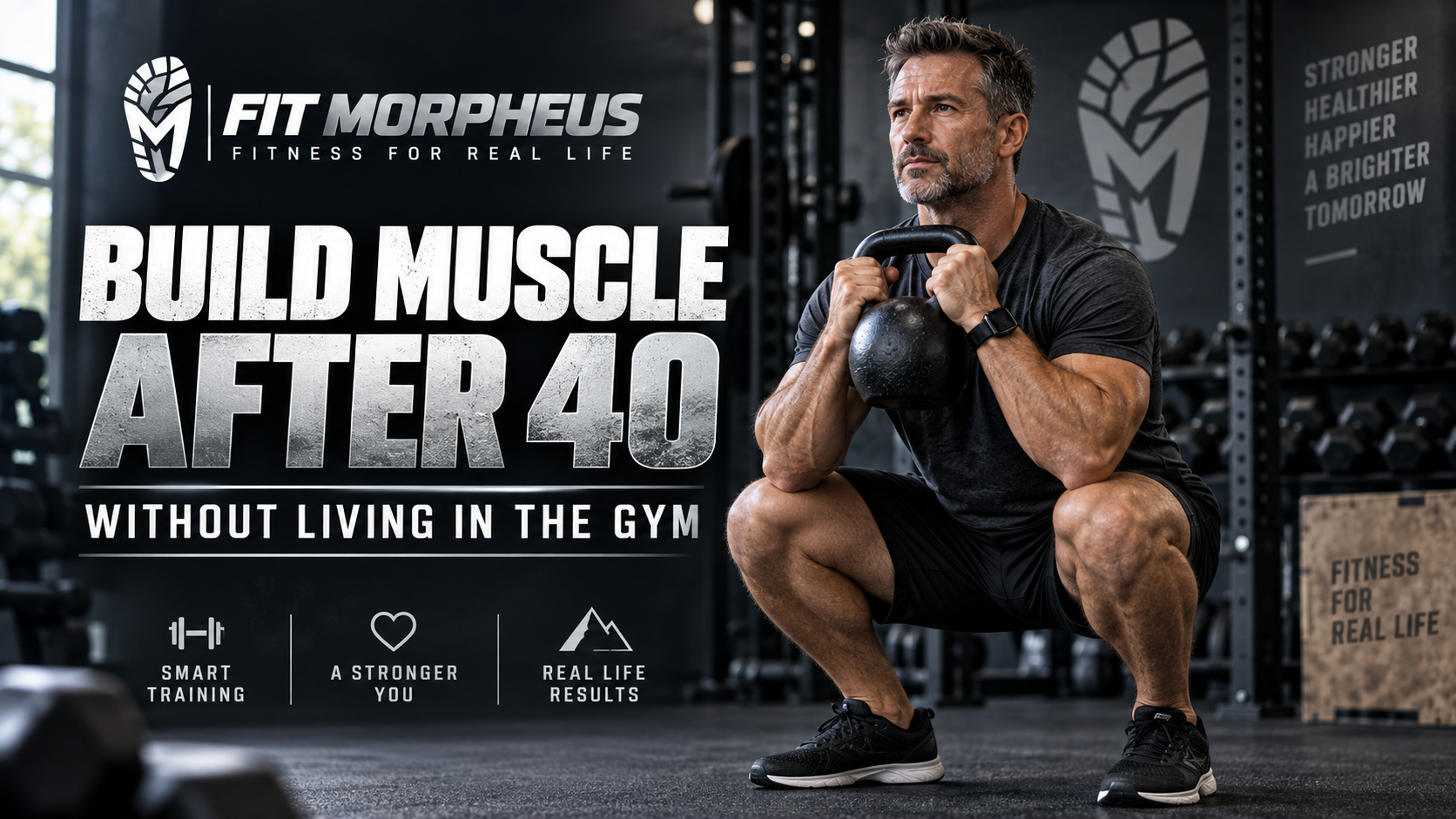
Building muscle after 40 is absolutely possible.
What usually changes is not your ability to grow muscle.
It is your tolerance for wasting time.
At 22, you might be willing to spend six days a week in the gym, try every new exercise you see online, skip sleep, eat whatever is convenient, and still make progress.
At 42, 48, or 55, that approach becomes less attractive.
You may have:
- A demanding job
- Family responsibilities
- Less free time
- Old injuries
- More stress
- Less interest in living at the gym
That does not mean your best physical years are behind you.
It means your training needs to become more efficient.
At Fit Morpheus, the goal is not to build a life around workouts.
It is to build a body that supports the life you already have.
And yes, that includes adding muscle.
Can You Still Build Muscle After 40?
Yes.
Muscle responds to resistance training throughout adulthood.
The basic process remains the same:
You challenge muscle tissue.
You recover.
Your body adapts.
Over time, that can lead to increases in strength and muscle size.
What often changes with age is the context around training.
People may:
- Move less
- Sleep less
- Eat less protein
- Accumulate injuries
- Train inconsistently
- Spend more time sitting
- Recover poorly
Those factors can make muscle gain harder.
But harder is not the same as impossible.
Muscle Matters for More Than Appearance
It is easy to think of muscle as cosmetic.
Bigger arms.
Broader shoulders.
More defined legs.
But muscle is also useful tissue.
It helps you:
- Lift
- Carry
- Climb
- Stabilize joints
- Maintain balance
- Perform physical work
- Stay independent as you age
That makes muscle a practical investment.
You do not need to become a bodybuilder.
But maintaining and building lean tissue can improve what your body is capable of doing.
You Do Not Need Six Gym Days Per Week
One of the biggest misconceptions about muscle gain is that more gym time automatically means more muscle.
It does not.
You need enough training to create a meaningful stimulus.
Then you need enough recovery to adapt.
For many adults over 40, somewhere around:
2–4 strength-training sessions per week
can work extremely well.
That is enough frequency to train the major muscle groups regularly without requiring your schedule to revolve around the gym.
Three Days Per Week Is a Great Sweet Spot
If you want to build muscle while keeping training practical, three full-body sessions per week is hard to beat.
For example:
Monday
- Squat
- Push
- Pull
- Hinge
- Carry
Wednesday
- Single-leg movement
- Push
- Pull
- Hinge
- Core
Friday
- Squat or lunge
- Press
- Row
- Hinge
- Carry
That covers a lot of territory.
You can train your whole body three times per week without needing a body-part split that requires five or six days in the gym.
Focus on the Big Movement Patterns
You do not need a giant exercise list.
Build your training around:
- Squat
- Hinge
- Push
- Pull
- Carry
- Single-leg work
Useful exercises include:
- Goblet squats
- Split squats
- Deadlifts
- Romanian deadlifts
- Push-ups
- Dumbbell presses
- Rows
- Pull-downs
- Pull-ups
- Farmer’s carries
These exercises train large amounts of muscle and give you more return for your time.
Use Isolation Work Strategically
Isolation exercises can still be useful.
Examples:
- Biceps curls
- Triceps extensions
- Lateral raises
- Leg curls
- Calf raises
There is nothing wrong with them.
But if you only have 45 minutes, start with the larger movements.
Then add isolation work if time allows.
Think:
Big rocks first. Small rocks second.
Progressive Overload Still Drives Progress
If your training never gets harder, your body has little reason to keep adapting.
That is where progressive overload comes in.
Over time, you can progress by:
- Adding weight
- Adding reps
- Adding sets
- Improving range of motion
- Improving control
- Using a harder variation
You do not need to add weight every workout.
Progress happens across weeks and months.
Stop Training Like Every Set Is a Test
You do not need to prove your strength every time you train.
Constantly chasing max effort can create a lot of fatigue.
For many sets, stop when you feel like you could perform another:
1–3 quality repetitions.
That still provides plenty of training stimulus.
You do not need to collapse after every set to grow muscle.
How Many Sets Do You Need?
There is no perfect number.
But beginners and intermediate lifters often make good progress with a moderate amount of weekly volume.
A practical starting point is:
2–4 working sets per exercise
performed across:
5–7 exercises
per session.
That is enough to create a solid stimulus without turning every workout into a marathon.
Repetition Ranges for Muscle Growth
You can build muscle across a fairly broad range of repetitions.
A simple way to organize training is:
Heavier Work
5–8 reps
Useful for strength and muscle.
Moderate Work
8–12 reps
A classic muscle-building range.
Higher-Rep Work
12–20 reps
Useful for some accessory exercises.
You do not need to choose one range forever.
Use a mix.
Your Workouts Should Be Hard Enough to Matter
Efficient training does not mean easy training.
If you finish every set feeling like you could have done 10 more reps, the stimulus may be too low.
The goal is:
Challenging but controlled.
Most sets should require real effort without turning into ugly, grinding repetitions.
Muscle Growth Requires Recovery
You do not build muscle during the workout.
The workout creates the stimulus.
Recovery allows adaptation.
That makes recovery one of the most important parts of muscle gain after 40.
Pay attention to:
- Sleep
- Nutrition
- Stress
- Training volume
- Rest days
If you are constantly exhausted, your program may be asking for more than you can recover from.
Sleep Is Part of Muscle Building
You can have a great training program and still undermine it with poor sleep.
Aim to make sleep a real priority.
That does not mean every night has to be perfect.
But consistently sleeping too little makes recovery harder.
Think of sleep as part of the program.
Not something separate from it.
Protein Matters More Than Most People Realize
If you are trying to build muscle, protein deserves attention.
A practical target for many active adults is roughly:
1.6 grams of protein per kilogram of body weight per day
with some people doing well somewhat below or above that depending on body size, training, and goals.
For a 180-pound person, that is roughly:
130 grams per day
You do not need to eat all of it at one meal.
Spread it across the day.
Make Protein Easy
Build each meal around a useful protein source.
Examples:
- Eggs
- Greek yogurt
- Cottage cheese
- Chicken
- Turkey
- Lean beef
- Fish
- Tofu
- Tempeh
- Beans
- Protein powder
Protein powder is convenient.
It is not required.
Use whatever makes consistency easier.
Do You Need a Calorie Surplus?
If you want to maximize muscle gain, a small calorie surplus can help.
But you do not need an aggressive bulk.
Eating far above maintenance often leads to more fat gain than muscle gain.
A modest surplus is usually more practical.
You want enough energy to support training and growth without turning muscle gain into uncontrolled weight gain.
Can You Build Muscle While Losing Fat?
Sometimes.
This is especially realistic for:
- Beginners
- People returning after a long break
- People with higher body-fat levels
- People who improve both training and nutrition at the same time
More experienced lifters may find it slower.
If fat loss is your primary goal, focus on preserving and gradually building muscle while maintaining a moderate calorie deficit.
Carbohydrates Help You Train
Carbohydrates are not the enemy.
They help support:
- Strength training
- Glycogen storage
- Higher-intensity work
- Recovery
You do not need huge amounts.
But if your workouts feel flat and you are eating very low carbohydrate, increasing carbs around training may help.
Useful options include:
- Rice
- Potatoes
- Oats
- Fruit
- Whole grains
- Beans
Do Not Ignore Fat
Dietary fat also matters.
Useful sources include:
- Olive oil
- Nuts
- Seeds
- Eggs
- Fatty fish
- Dairy
You do not need to go extremely low fat to get lean.
Balance matters.
Strength Training After 40 Should Be Efficient
Your training should give you a high return on time.
That means:
- Fewer junk sets
- Fewer random exercises
- More emphasis on progression
- More consistency
- Better recovery
A 45-minute focused workout can outperform a 90-minute unfocused workout.
A Practical 45-Minute Muscle-Building Workout
Here is an example.
Goblet Squat
3 sets of 8–12
Dumbbell Bench Press
3 sets of 8–12
One-Arm Dumbbell Row
3 sets of 8–12 per side
Romanian Deadlift
3 sets of 8–12
Farmer’s Carry
3 rounds
Optional
One or two quick accessory movements if time allows.
That is enough.
You do not need 14 exercises.
A Three-Day Example Plan
Day 1
- Goblet squat
- Dumbbell bench press
- Dumbbell row
- Romanian deadlift
- Farmer’s carry
Day 2
- Step-up
- Overhead press
- Lat pulldown
- Kettlebell deadlift
- Core work
Day 3
- Split squat
- Push-up
- Seated row
- Hip hinge
- Suitcase carry
Progress the loads and repetitions gradually.
That is a legitimate muscle-building program.
Do You Need Machines?
No.
But machines can be useful.
They provide stability and can make it easier to focus on specific muscles.
Free weights and bodyweight exercises provide more coordination demands.
Use both if you enjoy them.
You do not need to be loyal to one training style.
Bodyweight Training Can Build Muscle Too
Push-ups.
Pull-ups.
Split squats.
Step-ups.
Lunges.
Bodyweight training can absolutely contribute to muscle growth, especially when the exercises are progressed.
The key is still the same:
The movement must become challenging enough to create adaptation.
Do Not Confuse Soreness With Growth
A workout does not have to make you sore to build muscle.
Soreness often increases when:
- You try a new exercise
- You increase volume suddenly
- You return after time off
That does not automatically mean the workout was more productive.
A better question is:
Am I getting stronger over time?
That tells you more.
Track Your Training
Keep a simple log.
Record:
- Exercise
- Weight
- Reps
- Sets
Then compare across weeks.
If you are gradually lifting more weight or performing more controlled reps, your training is progressing.
Muscle growth tends to follow consistent progressive training.
Measure More Than the Scale
If muscle gain is your goal, track more than body weight.
Useful measures include:
- Strength
- Waist
- Arm or leg measurements
- Progress photos
- How clothes fit
- Workout performance
You may gain muscle without dramatic scale changes.
Building Muscle After 40 Requires Patience
Muscle growth is slow.
That is normal.
You are not failing because you did not transform in six weeks.
Think in:
Months
not:
Days.
The biggest advantage you have after 40 is perspective.
You know consistency matters.
Use that.
What Usually Stops Progress
The biggest problems are usually not genetics.
They are:
- Inconsistent training
- Not enough protein
- Constant program changes
- Too little sleep
- Too much volume
- No progression
- Unrealistic expectations
Fix those first.
You Do Not Need to Live in the Gym
This is the main point.
To build muscle after 40, you do not need:
- Six gym days
- Two-hour workouts
- Constant soreness
- Endless supplements
- Complicated programs
You need:
- Consistent resistance training
- Progressive overload
- Enough protein
- Enough food
- Good sleep
- Enough recovery
That is it.
Simple does not mean easy.
But simple is sustainable.
Build Muscle That Improves Your Life
At Fit Morpheus, muscle is not the final goal.
Capability is.
Build muscle so you can:
- Carry more
- Climb easier
- Hike farther
- Move confidently
- Stay independent
- Handle physical work
Train for a stronger body.
But make sure that stronger body is useful.
Fit Morpheus
You do not need to live in the gym to build muscle after 40. You need a plan you can recover from and repeat.
Train hard.
Recover well.
Eat enough protein.
Stay consistent.
Fitness for real life.
References
American College of Sports Medicine — Resistance Training Guidance. Consistent resistance training supports improvements in strength, muscle size, and physical function.
International Society of Sports Nutrition — Protein and Exercise. Evidence supports higher protein intakes for active adults seeking to build or preserve muscle.
Physical Activity Guidelines for Americans. Adults are encouraged to perform muscle-strengthening activity at least two days per week.
Educational Disclaimer: This article provides general fitness and nutrition education and is not individualized medical advice. People with significant orthopedic, cardiovascular, metabolic, or other medical conditions should consult an appropriate healthcare professional before substantially changing exercise or diet.