Getting enough protein becomes increasingly important as you get older.
Not because something magical happens on your 40th birthday.
And not because your body suddenly stops responding to training.
The real issue is that maintaining muscle becomes more important with age, while many adults gradually become less active, eat less protein, and do less resistance training.
That combination can slowly work against you.
If your goal is to stay strong, build muscle, improve body composition, recover from training, and remain capable later in life, protein deserves more attention than simply asking:
“Did I eat some meat today?”
At Fit Morpheus, nutrition is not about chasing perfect numbers.
It is about eating in a way that supports what you want your body to be capable of doing.
Protein is one of the biggest pieces of that equation.
Why Protein Matters More After 40
Protein provides amino acids your body uses to build and repair tissue.
That includes muscle.
When you perform resistance training, you create a stimulus that tells your body to adapt.
Protein provides many of the raw materials needed for that process.
As we age, preserving lean muscle becomes especially important because muscle supports much more than appearance.
It contributes to:
- Strength
- Mobility
- Balance
- Metabolic health
- Physical function
- Recovery
- Independence
- The ability to work, hike, lift, carry, and play
Muscle is useful tissue.
That makes protein useful nutrition.
Do Protein Needs Increase With Age?
For many adults, they can.
The standard Recommended Dietary Allowance for protein is approximately:
0.8 grams per kilogram of body weight per day
But that amount is designed primarily to prevent deficiency in most healthy adults.
It is not necessarily the optimal target for someone who is physically active, resistance training, trying to build muscle, or trying to preserve lean mass while losing fat.
Research and expert groups focused on aging commonly suggest that older adults may benefit from intakes above the basic RDA.
The PROT-AGE Study Group, for example, has recommended around 1.0–1.2 g/kg/day for healthy older adults, with higher intakes often suggested for active people.
For people performing regular resistance training, the useful target can be higher still.
A Practical Protein Target After 40
For many healthy adults over 40 who strength train and want to maintain or build muscle, a practical range is:
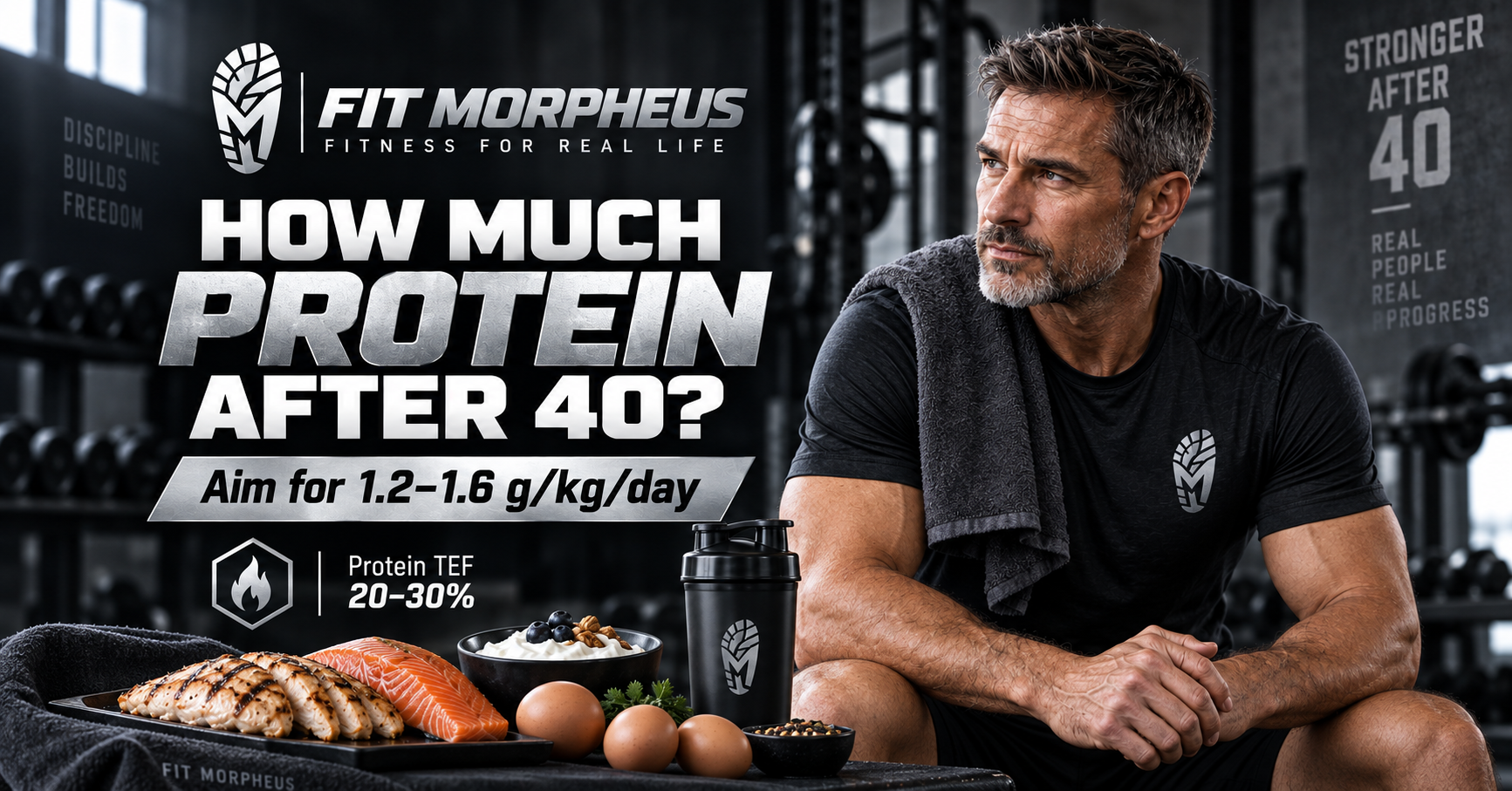
1.2–1.6 grams of protein per kilogram of body weight per day
For someone focused heavily on muscle gain or retaining muscle during a calorie deficit, intake toward the upper end of that range can make sense.
A large meta-analysis of resistance-training studies found that protein intakes around 1.6 g/kg/day appeared to capture most of the muscle-building benefit for many healthy adults, with little additional average gain above that level.
That does not mean 1.6 g/kg is a magic cutoff.
It is simply a useful evidence-based target.
Protein Targets by Body Weight
Here is what that range looks like in real life.
| Body Weight | 1.2 g/kg | 1.6 g/kg |
|---|---|---|
| 140 lb | ~76 g | ~102 g |
| 160 lb | ~87 g | ~116 g |
| 180 lb | ~98 g | ~131 g |
| 200 lb | ~109 g | ~145 g |
| 220 lb | ~120 g | ~160 g |
You do not need to hit the exact number every day.
Think of protein as a target range rather than a pass-or-fail test.
What About 1 Gram of Protein Per Pound?
You will often hear:
“Eat one gram of protein per pound of body weight.”
That is simple to remember, but it is more than many people need.
For a 200-pound person, that would mean 200 grams per day.
That may be perfectly reasonable for some athletes or larger, lean individuals.
But it is not automatically necessary.
For many recreational lifters over 40, somewhere around 0.55–0.75 grams per pound provides a very practical range.
That corresponds roughly to the 1.2–1.6 g/kg range above.
If You Have a Lot of Weight to Lose, Use Some Judgment
Calculating protein strictly from total body weight can produce unnecessarily high numbers for someone carrying substantial excess body fat.
For example, if someone weighs 300 pounds, multiplying that number by one gram per pound would produce a target of 300 grams of protein.
That is probably not necessary.
In those situations, a protein target based on:
- Goal body weight
- Estimated lean body mass
- A reasonable target-weight range
may be more practical.
The point is not to chase the largest protein number possible.
The point is to eat enough to support muscle and recovery.
Protein After 40 and Muscle Protein Synthesis
Your muscles are constantly going through cycles of breakdown and rebuilding.
Eating protein stimulates muscle protein synthesis—the process your body uses to build new muscle proteins.
Resistance training also stimulates this process.
Put the two together and you create a strong environment for maintaining or building muscle.
This is one reason strength training and adequate protein work so well together.
Protein without resistance training is helpful.
Resistance training without enough protein can still work.
But combining them is better.
Why Protein Distribution Matters
You do not need to obsess over protein timing.
Your total daily intake matters most.
But spreading protein across the day can make it easier to reach your target and repeatedly provide amino acids to muscle tissue.
Instead of eating almost no protein all day and then consuming 80 grams at dinner, consider including meaningful amounts at several meals.
A simple target might be:
25–40 grams of protein per meal
depending on your body size, total daily target, and number of meals.
For example:
Breakfast
30 grams
Lunch
35 grams
Snack
20 grams
Dinner
40 grams
Total:
125 grams
That is often much easier than trying to “catch up” late at night.
Protein at Breakfast Is Often the Missing Piece
Dinner usually is not the problem.
Breakfast often is.
A typical breakfast might include:
- Toast
- Cereal
- Fruit
- Coffee
There is nothing inherently wrong with those foods.
But protein can be very low.
Adding:
- Eggs
- Greek yogurt
- Cottage cheese
- Protein powder
- Lean breakfast meat
- High-protein milk
can dramatically increase your daily intake without changing the rest of your diet much.
Protein Also Helps With Fat Loss
Protein is especially useful when you are trying to lose fat.
A calorie deficit causes body weight to decrease.
But the goal should usually be to lose primarily fat while preserving as much lean tissue as possible.
Higher protein intake combined with resistance training can help support muscle retention during dieting.
Protein may also help with appetite control.
That makes a higher-protein diet useful for body composition—not because protein magically burns fat, but because it can make a calorie-controlled diet easier to sustain while supporting muscle.
Protein Has a Higher Thermic Effect Than Carbohydrate or Fat
This is one of the most interesting characteristics of protein.
Your body does not simply absorb food calories for free.
Digesting, absorbing, transporting, and metabolizing nutrients requires energy.
This is called the:
Thermic Effect of Food, or TEF.
Different macronutrients require different amounts of energy to process.
Approximate thermic effects commonly reported are:
- Fat: 0–3%
- Carbohydrate: 5–10%
- Protein: 20–30%
Protein has by far the highest thermic effect of the three major macronutrients.
What Does a 20–30% Thermic Effect Actually Mean?
Suppose you eat:
100 calories of protein.
Your body may use roughly:
20–30 calories
simply digesting and processing that protein.
That does not mean protein only contains 70–80 usable calories in every real-world situation.
Human energy metabolism is more complicated than that.
But it does demonstrate why protein-rich meals tend to produce a larger post-meal rise in energy expenditure compared with meals dominated by fat or carbohydrate.
Protein is the most thermogenic macronutrient.
Does Eating More Protein Boost Your Metabolism?
Technically, yes—but the size of the effect needs context.
A higher-protein diet generally increases diet-induced thermogenesis because your body spends more energy processing protein.
That means two diets containing the same number of calories may produce slightly different net energy expenditure depending on macronutrient composition.
But this is not a metabolic cheat code.
Eating an extra 1,000 calories of steak will not somehow make you lose weight because protein has a high thermic effect.
Total energy balance still matters.
The thermic effect simply gives higher-protein diets a modest metabolic advantage compared with lower-protein diets.
An Example of Protein’s Thermic Advantage
Imagine two 2,000-calorie diets.
One contains relatively little protein.
The other replaces some carbohydrate or fat calories with protein.
Because more energy is required to digest and metabolize protein, the higher-protein diet may result in somewhat greater diet-induced energy expenditure.
A 2024 meta-analysis examining varying protein amounts confirmed that protein is highly thermogenic, although the magnitude of the effect varies depending on the meal and study conditions.
So yes:
Increasing protein can slightly increase daily calorie expenditure.
But the more important benefits are usually:
- Muscle preservation
- Muscle growth
- Satiety
- Recovery
- Improved dietary structure
Think of the thermic effect as a bonus.
Not the primary reason to eat protein.
Protein May Help You Feel Fuller
Protein is also generally more satiating than many low-protein foods.
That matters during fat loss.
A meal containing:
- Chicken
- Potatoes
- Vegetables
may keep you satisfied longer than the same calories coming mostly from highly processed carbohydrate and fat.
That can reduce the desire to keep eating later.
The combination of greater satiety and a higher thermic effect is one reason higher-protein diets are often useful for body composition.
Do You Need Protein Immediately After Training?
The famous “30-minute anabolic window” has been exaggerated.
You do not need to sprint to your protein shake the moment your last set ends.
Your muscles remain responsive to protein for much longer than 30 minutes.
But consuming protein somewhere near your workout is still practical.
For example:
1–3 hours before or after training
works well for most people.
If you train first thing in the morning without eating, having protein after training becomes more useful.
If you ate a protein-rich meal shortly before training, there is less urgency.
Protein Before Bed
Protein before bed can also contribute to your daily intake and provide amino acids during the overnight period.
Useful options include:
- Greek yogurt
- Cottage cheese
- Milk
- Casein protein
- A regular protein-rich meal
This is optional.
It is not necessary if you already meet your daily target.
Animal Protein vs Plant Protein
You can build muscle with either.
Animal proteins such as:
- Meat
- Poultry
- Fish
- Eggs
- Dairy
generally contain all essential amino acids and often provide relatively high amounts of leucine.
Plant proteins include:
- Beans
- Lentils
- Soy
- Tofu
- Tempeh
- Peas
- Whole grains
- Nuts
- Seeds
Plant-based diets can absolutely provide enough protein.
You may simply need a little more planning and variety.
Leucine and Muscle Building
Leucine is an essential amino acid that plays an important role in triggering muscle protein synthesis.
Foods naturally rich in leucine include:
- Whey
- Dairy
- Eggs
- Beef
- Chicken
- Fish
- Soy
You generally do not need to buy separate leucine supplements if you eat enough high-quality protein throughout the day.
Do You Need Protein Powder?
No.
Protein powder is food convenience.
Nothing more.
If you can meet your protein needs with whole foods, great.
If drinking a shake makes it easier to reach 130 grams instead of ending the day at 75 grams, protein powder can be useful.
Common options include:
- Whey
- Casein
- Soy
- Pea
- Plant blends
Choose based on tolerance, preference, and diet.
Whole Foods Should Still Do Most of the Work
A protein shake can be useful.
But protein intake should not turn your diet into:
Shake.
Bar.
Shake.
Bar.
Build most meals around real food.
That gives you protein along with vitamins, minerals, fiber, healthy fats, and other nutrients.
Easy High-Protein Foods
Good choices include:
- Chicken breast
- Turkey
- Lean beef
- Salmon
- Tuna
- Shrimp
- Eggs
- Greek yogurt
- Cottage cheese
- Milk
- Tofu
- Tempeh
- Lentils
- Beans
- Edamame
Convenience matters.
Choose foods you will actually eat consistently.
A Sample 130-Gram Protein Day
Here is one simple example.
Breakfast
3 eggs + Greek yogurt
~35 grams
Lunch
5–6 ounces chicken with rice and vegetables
~40 grams
Snack
Protein shake
~25 grams
Dinner
5 ounces salmon with potatoes and vegetables
~30 grams
Daily total:
~130 grams
That is enough for many active adults without eating enormous portions or consuming protein every two hours.
Protein During a Calorie Deficit
If you are trying to lose body fat, protein becomes particularly valuable.
During a calorie deficit, your body receives less energy than it expends.
Resistance training tells your body:
Keep this muscle.
Protein helps provide the material to support that process.
For that reason, people dieting aggressively or already relatively lean may benefit from prioritizing protein even more.
Protein During Muscle Gain
If you are deliberately trying to build muscle, protein is still important.
But once you are eating enough protein, simply adding more is not necessarily better.
If you are already around:
1.6 g/kg/day
adding another 50 or 100 grams may provide little additional muscle-building benefit for most people.
At that point, overall calories, training quality, sleep, and consistency may matter more.
More Protein Is Not Automatically Better
Nutrition advice often becomes extreme.
If 130 grams is good, surely 250 grams must be better.
Not necessarily.
Once you meet your needs, extra protein has diminishing returns.
It can also crowd out foods that provide:
- Fiber
- Healthy fats
- Carbohydrates
- Fruit
- Vegetables
- Micronutrients
Protein is important.
It should not become your entire diet.
What About Kidney Health?
For healthy people, higher-protein diets within reasonable ranges are generally considered safe.
But protein recommendations become more complicated for people with certain kidney conditions.
People with chronic kidney disease may need individualized protein targets, and recommendations can differ significantly depending on disease stage, nutritional status, and treatment.
If you have known kidney disease or another condition requiring dietary protein restriction, do not simply follow generic high-protein recommendations.
Work with your physician or registered dietitian.
The Best Protein Strategy Is the One You Can Maintain
You do not need to weigh every chicken breast forever.
Tracking for a short period can teach you what 100, 120, or 150 grams of protein actually looks like.
After that, you may be able to estimate fairly well.
A simple approach is:
Build every major meal around protein.
Then fill the rest of your plate with:
- Vegetables
- Fruit
- Quality carbohydrates
- Healthy fats
That works for a lot of people.
Protein Is Only One Part of Building Muscle After 40
You cannot eat your way around poor training.
Protein works best when paired with resistance training.
You still need to:
- Squat
- Hinge
- Push
- Pull
- Carry
- Progress your training
Protein supports the adaptation.
Training creates the reason for adaptation.
For a practical training approach, read:
How to Build Muscle After 40 Without Living in the Gym.
The Fit Morpheus Protein Approach
After 40, protein is not about becoming obsessed with macros.
It is about supporting the body you want to keep.
For many active adults:
1.2–1.6 g/kg/day is a practical target.
Spread it across several meals.
Combine it with resistance training.
Eat enough total calories to support your goal.
And remember that protein provides an additional advantage:
It takes more energy to digest and metabolize than carbohydrate or fat.
But do not chase protein simply because it burns a few extra calories.
Eat it because it helps you:
Build muscle.
Preserve strength.
Recover.
Control hunger.
Stay capable.
That is what matters.
Eat to build the body you want to live in—not simply to weigh less.
Fitness for real life.
Learn more about Lifestyle Fitness.
References
The PROT-AGE Study Group recommends roughly 1.0–1.2 g/kg/day for healthy older adults and at least around 1.2 g/kg/day for many active older adults.
A large meta-analysis of resistance-training studies found that protein supplementation improved gains in strength and fat-free mass, with benefits tending to level off around 1.6 g/kg/day in healthy adults performing resistance training.
Reviews of diet-induced thermogenesis report approximate thermic effects of 20–30% for protein, 5–10% for carbohydrate, and 0–3% for fat.
A 2024 meta-analysis further examined the effect of protein amount and type on diet-induced thermogenesis and confirms protein as the most thermogenic macronutrient.
Educational Disclaimer: This article provides general nutrition and fitness education and is not individualized medical advice. Protein needs may differ with kidney disease, liver disease, pregnancy, illness, medication use, or other medical conditions. Consult an appropriate healthcare professional or registered dietitian when individualized guidance is needed.