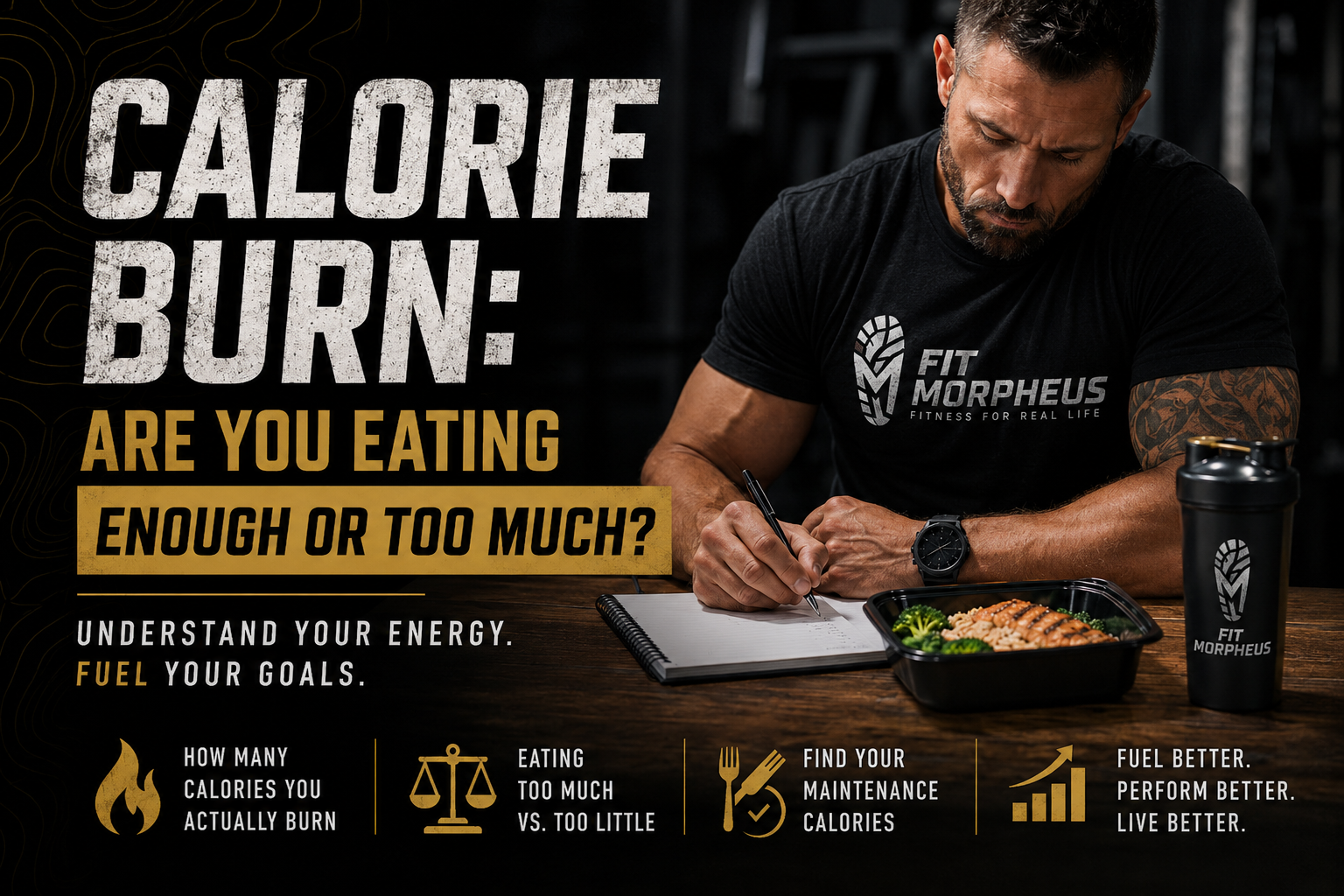
Are You Eating Enough—or Too Much?
Most people think about calories backward.
They look at their watch after a workout, see that they burned 400 calories, and start calculating how much food they “earned.” Or they decide they need to lose weight, cut their intake to 1,200 or 1,500 calories, and assume eating less will automatically produce better results.
Neither approach tells the whole story.
Your body is burning calories 24 hours a day, whether you are running, lifting weights, walking through the grocery store, sitting at a desk, or sleeping.
In fact, for most people, exercise represents only a portion of total daily calorie expenditure.
Understanding where those calories go—and how many you actually need—is one of the most useful things you can learn about nutrition.
Because the question isn’t simply:
“How many calories should I eat?”
A better question is:
“How much energy does my body actually use, and how should my food intake support what I want my body to do?”
That could mean losing fat.
It could mean building muscle.
It could mean maintaining your weight.
Or it could simply mean having enough energy to work, train, recover, sleep, and enjoy your life.
Let’s break it down.
Your Body Burns Calories Even When You Do Nothing
Imagine spending an entire day lying in bed.
No workout.
No yard work.
No 10,000 steps.
You would still burn a significant number of calories.
Your heart has to beat. Your lungs have to breathe. Your brain requires energy. Your liver, kidneys, digestive system, nervous system, and other organs are constantly working.
The energy required to keep those basic systems functioning is referred to as your Basal Metabolic Rate (BMR) or, in practical settings, your Resting Metabolic Rate (RMR).
Although BMR and RMR are technically measured under slightly different conditions, they describe essentially the same concept for everyday nutrition:
The calories your body uses simply to stay alive.
For many adults, resting metabolism alone can account for roughly 1,300 to well over 2,000 calories per day, depending on sex, height, weight, age, body composition, and genetics.
That happens before you intentionally exercise.
Where Your Daily Calorie Burn Actually Comes From
Your Total Daily Energy Expenditure, commonly abbreviated TDEE, is everything your body burns throughout the day.
It can be divided into several major categories.
1. Resting Metabolic Rate
This is usually the largest component of daily calorie expenditure.
Your body is constantly spending energy to:
- Maintain body temperature
- Circulate blood
- Power your brain and nervous system
- Operate your organs
- Repair tissues
- Maintain cellular processes
- Breathe
- Keep you alive
Larger bodies generally require more energy than smaller bodies.
People with more lean mass also tend to have greater energy requirements, although the relationship isn’t as dramatic as social media sometimes makes it sound.
Age also matters. As people get older, calorie requirements often decrease somewhat, particularly when aging is accompanied by reductions in muscle mass and physical activity.
2. NEAT: The Calorie Burn Most People Ignore
NEAT stands for Non-Exercise Activity Thermogenesis.
That’s a complicated name for a very simple idea:
It’s all the movement you do that isn’t technically exercise.
Examples include:
- Walking through the office
- Taking the stairs
- Standing while talking
- Cleaning the house
- Shopping
- Cooking
- Doing laundry
- Working in the garage
- Playing with your kids
- Gardening
- Walking the dog
- Fidgeting
- Changing positions
- Getting up and down throughout the day
Two people can perform the exact same one-hour workout and still have dramatically different daily calorie expenditure because one spends the remaining 15 waking hours moving while the other spends them sitting.
This is one reason I don’t like reducing fitness to what happens during a 45-minute workout.
Your body experiences your entire day—not just your gym session.
3. The Thermic Effect of Food
It actually takes energy to digest food.
Your body has to break food down, absorb nutrients, transport them, and either use or store them.
This is called the Thermic Effect of Food, or TEF.
Different macronutrients require different amounts of energy to process.
Protein generally has the highest thermic effect, followed by carbohydrates and then fat.
This is one of several reasons protein can be particularly useful when trying to improve body composition.
It helps support muscle tissue, increases satiety for many people, and requires more energy to digest than fat or carbohydrates.
That doesn’t make protein a magic fat burner.
It simply means that 100 calories eaten doesn’t necessarily equal exactly 100 calories available for storage or activity after digestion.
Human metabolism is more complicated than simple calculator math.
4. Exercise and Intentional Activity
Finally, we have the category everyone thinks about first:
Exercise.
Running.
Cycling.
Hiking.
Swimming.
Sports.
Walking for exercise.
Those calories certainly matter.
But exercise should be viewed as one component of your total energy expenditure, not the entire equation.
That distinction is especially important when looking at fitness watches.
Resting Calories vs. Active Calories on a Fitness Watch
Many fitness trackers divide calorie expenditure into two numbers:
Resting Energy and Active Energy.
If your watch says:
- Resting Energy: 1,750 calories
- Active Energy: 550 calories
Your body did not burn only 550 calories that day.
Your approximate total would be:
1,750 + 550 = 2,300 calories
And even that number should be considered an estimate rather than a laboratory measurement.
Wearable devices can be useful for identifying trends, but you shouldn’t assume every calorie displayed on your watch is perfectly accurate.
Your real-world body weight, food intake, activity level, performance, recovery, and measurements over time often provide better feedback.
How Many Calories Does the Average Office Worker Burn?
There isn’t one universal number.
A 5’2″, 125-pound woman and a 6’3″, 230-pound man don’t have identical energy requirements just because they both work at desks.
But we can establish reasonable starting ranges.
For a relatively sedentary adult who works primarily at a desk and does little intentional exercise:
| Approximate Resting Burn | Approximate Sedentary Daily Burn | |
|---|---|---|
| Average Adult Female | ~1,300–1,600 calories | ~1,600–1,900+ calories |
| Average Adult Male | ~1,600–1,900 calories | ~2,000–2,300+ calories |
These aren’t targets.
They’re examples.
A taller, heavier or more muscular person may require significantly more. A smaller or older person may require less.
And once you add several thousand steps, physical work, strength training, running, hiking, sports, or other activity, daily calorie expenditure can rise substantially.
The NIH Body Weight Planner, for example, uses personal information including age, height, weight, sex, and physical activity rather than assuming everyone has the same calorie needs. It describes physical-activity levels ranging from roughly 1.4 for sedentary lifestyles to much higher levels for very active individuals.
How to Estimate Your Resting Calorie Burn
One commonly used equation is the Mifflin-St Jeor equation.
It was developed from measured resting energy expenditure in hundreds of adults and remains one of the better-known prediction equations for estimating resting metabolic rate.
You’ll need:
- Weight in kilograms
- Height in centimeters
- Age
For Men
RMR = (10 × weight in kg) + (6.25 × height in cm) − (5 × age) + 5
For Women
RMR = (10 × weight in kg) + (6.25 × height in cm) − (5 × age) − 161
Here’s an example.
A 45-year-old man who is:
- 6’0″
- 170 pounds
- 45 years old
has an estimated resting requirement of approximately:
1,690 calories per day.
That doesn’t mean he should eat 1,690 calories.
It means his body may burn around that amount before accounting for most normal daily activity and exercise.
That’s a very important difference.
Going From Resting Calories to Total Calories
A quick way to approximate total daily expenditure is to multiply resting metabolism by an activity factor.
Typical starting estimates might look something like this:
| Lifestyle | Approximate Multiplier |
| Very sedentary | 1.2 |
| Lightly active | 1.35–1.4 |
| Moderately active | 1.5–1.6 |
| Very active | 1.7+ |
Take our hypothetical man with a resting expenditure of 1,690 calories.
If he’s primarily an office worker:
1,690 × 1.2 = 2,028 calories
If he walks regularly and trains several days per week:
1,690 × 1.5 = 2,535 calories
If he’s extremely active, his needs could climb considerably higher.
These multipliers are estimates, not biological laws.
Your actual maintenance intake is better identified by combining an estimate with real-world data over several weeks.
Your Weight Is One of the Best Feedback Tools You Have
Let’s say a calorie calculator predicts that you maintain your weight at 2,400 calories.
You consistently eat roughly 2,400 calories for three weeks.
Your average body weight remains essentially unchanged.
Congratulations.
Your real-world maintenance calorie intake is probably somewhere around 2,400 calories.
Now suppose you’re eating 2,400 calories and your average body weight continues increasing.
Your actual maintenance level is probably lower.
If your weight steadily decreases, your maintenance level is probably higher.
Your body is giving you information.
Use it.
Don’t React to One Day on the Scale
Body weight doesn’t change only because of fat.
Your scale can move because of:
- Water retention
- Sodium
- Carbohydrate intake
- Glycogen storage
- Food still in your digestive system
- Alcohol
- Hormonal changes
- Stress
- Sleep
- Inflammation following hard training
- Bowel movements
You might gain three pounds overnight.
You did not suddenly gain three pounds of body fat.
Instead of obsessing over individual weigh-ins, look at the trend.
If you’re comfortable weighing yourself regularly, weigh under similar conditions and look at a 7-day average.
Then compare averages from week to week.
That’s much more useful than allowing Tuesday morning’s scale number to determine your mood.
How Do You Know If You’re Eating Too Much?
The most obvious sign of a sustained calorie surplus is a gradual increase in body mass.
That’s not automatically bad.
Someone deliberately trying to build muscle may intentionally eat slightly above maintenance.
A teenager growing rapidly will have different needs.
An athlete may require substantially more energy.
But if your goal is weight maintenance or fat loss and your average weight and waist measurement continue climbing over several weeks, you’re probably consuming more energy than you’re using.
The culprit isn’t always dinner.
A calorie surplus can quietly accumulate through:
- Sweetened coffee drinks
- Alcohol
- Restaurant portions
- Cooking oils
- Salad dressings
- Snacks while cooking
- Condiments
- Weekend eating
- Liquid calories
- Grazing
- Large portions of calorie-dense “healthy” foods
Foods can be nutritious and calorie dense.
Olive oil is nutritious.
Peanut butter can be nutritious.
Nuts can be nutritious.
Avocados can be nutritious.
But calories still count.
Nutrition quality and energy balance are related concepts, but they are not the same thing.
The Weekend Can Undo the Week
Here’s a common pattern.
Someone decides to eat 500 calories below maintenance Monday through Friday.
That’s approximately:
500 × 5 = 2,500 calories
Then Saturday and Sunday include restaurant meals, drinks, appetizers, desserts, and snacks.
If they consume an extra 1,250 calories above maintenance each day:
1,250 × 2 = 2,500 calories
The weekly deficit disappears.
The person then says:
“I’ve been dieting all week and nothing works.”
Their metabolism isn’t necessarily broken.
They’re looking at their calories by day instead of by week.
Consistency matters more than perfection.
But Eating Too Little Can Also Be a Problem
This side of the conversation doesn’t get nearly enough attention.
Some people need to eat less.
Others are already eating too little.
And cutting calories even further isn’t always the answer.
Chronically under-fueling while demanding more and more from your body can affect training, recovery, mood, performance, and overall health.
Low energy availability is well recognized in sports medicine and can occur in both men and women when food intake doesn’t provide enough energy to support normal physiological function after exercise demands are accounted for.
Possible warning signs that deserve attention include:
- Constant fatigue
- Poor workout performance
- Declining strength
- Difficulty recovering
- Persistent soreness
- Feeling unusually cold
- Irritability
- Poor concentration
- Sleep problems
- Strong food cravings
- Recurrent injuries
- Reduced libido
- Menstrual disruption in women
- Difficulty maintaining muscle
- Obsessive thoughts about food or calories
None of these symptoms proves that you aren’t eating enough. Many medical conditions can cause similar symptoms.
But if you’re training hard while aggressively restricting food and experiencing several of them, simply cutting another 300 calories probably isn’t the smartest next move.
More Weight Loss Is Not Always Better Weight Loss
People understandably want fast results.
So they create enormous calorie deficits.
If 300 fewer calories is good, they assume 800 fewer must be better.
If 1,800 calories produces weight loss, they think 1,300 will produce even faster weight loss.
Initially, it might.
But your goal shouldn’t simply be to make the scale drop as quickly as humanly possible.
Ideally, you want to:
Lose fat while preserving muscle, performance, health, and a lifestyle you can actually maintain.
Large deficits can make that harder.
They can increase hunger, reduce training performance, make recovery more difficult, and make adherence increasingly miserable.
And weight-loss calculations aren’t perfectly linear because the body adapts as weight and energy intake change. NIH researchers specifically caution against assuming that the old “3,500 calories equals one pound forever” rule accurately predicts long-term weight change.
Your body isn’t a spreadsheet.
A Better Starting Point for Fat Loss
Instead of immediately attempting the lowest calorie intake you can tolerate, start around your estimated maintenance level and gather data.
Then create a moderate deficit.
For many adults, something around 10–20% below estimated maintenance can be a reasonable starting framework.
For example:
Estimated maintenance:
2,500 calories
10% deficit:
2,250 calories
20% deficit:
2,000 calories
You don’t necessarily need to drop to 1,400 calories to lose weight.
A smaller deficit that you can maintain consistently often beats a huge deficit followed by hunger, frustration, weekend overeating, and eventually quitting.
Individual needs vary considerably, particularly for people with medical conditions or substantial weight-loss goals. The NIH Body Weight Planner is one useful tool for modeling personalized calorie and activity changes rather than relying on one-size-fits-all numbers.
Want to Build Muscle? You Still Don’t Need a “Bulk”
The opposite mistake also happens.
Someone wants to build muscle and suddenly starts eating everything they can find.
Muscle growth requires:
- Resistance training
- Progressive overload
- Adequate protein
- Adequate energy
- Recovery
- Sleep
- Time
It does not require an enormous calorie surplus.
If you’re gaining body weight very rapidly, much of that additional weight isn’t likely to be new muscle tissue.
A modest surplus combined with intelligent strength training usually makes more sense than treating muscle gain as an excuse for unlimited calories.
Protein Changes the Conversation
Calories determine a large part of what happens to body weight.
But calories don’t tell you everything about body composition.
Imagine two people eating 2,000 calories.
Person A consumes very little protein and doesn’t resistance train.
Person B eats adequate protein and strength trains consistently.
Even if their scale weight responds similarly, their long-term body composition may not.
Protein helps support and preserve lean tissue, particularly when paired with resistance training.
Instead of only asking:
“How many calories am I eating?”
Also ask:
“What are those calories doing for me?”
Your food should provide:
- Protein
- Fiber
- Vitamins
- Minerals
- Essential fats
- Carbohydrates appropriate for your activity
- Enough total energy to support your goals
Calories matter.
Food quality matters.
Both statements can be true at the same time.
The Fit Morpheus 14-Day Calorie Reality Check
If you genuinely don’t know whether you’re eating too much or too little, stop guessing.
Spend two weeks gathering information.
Step 1: Estimate Your Maintenance Calories
Use a reputable calculator such as the NIH Body Weight Planner or calculate your estimated resting metabolism and apply an appropriate activity factor.
Don’t obsess over whether the number is exact.
It’s a starting point.
Step 2: Track Your Food for 14 Days
Don’t change your normal eating habits yet.
Record what you actually consume.
That includes:
- Drinks
- Cooking oils
- Sauces
- Snacks
- Alcohol
- Creamers
- Condiments
- Restaurant meals
You’re collecting data—not passing or failing a test.
Step 3: Weigh Consistently
If weighing yourself is appropriate for you, do it under similar circumstances.
Morning, after using the bathroom and before eating is convenient for many people.
Step 4: Calculate Weekly Averages
Ignore random daily fluctuations.
Compare your first 7-day average with your second.
Step 5: Look at the Relationship
If your weight is roughly stable:
Your current average intake is probably fairly close to maintenance.
If weight is trending upward:
You’re probably averaging a calorie surplus.
If weight is trending downward:
You’re probably averaging a calorie deficit.
Now you’re working with information from your actual body instead of blindly trusting a calculator.
Don’t Forget About Movement Outside the Gym
There’s another way to affect the equation besides continuously removing food:
Move more.
Not necessarily through brutal workouts.
Walk.
Take the stairs.
Stand up regularly.
Carry things.
Work outside.
Hike.
Play.
Do household projects.
Park farther away.
Take a 10-minute walk after lunch.
Break up long periods of sitting.
Your body was designed to move.
This is one reason the Fit Morpheus approach goes beyond traditional “exercise.”
Fitness should improve your ability to participate in your life—not simply your ability to perform exercises inside a gym.
A strong body that moves frequently will usually serve you better than a body that spends 23 hours sedentary and tries to undo it with one hour on a treadmill.
Your Fitness Tracker Is a Tool, Not a Permission Slip
Fitness watches are useful.
They can encourage movement and help you track:
- Steps
- Workouts
- Heart rate
- Activity trends
- Sleep
- Consistency
But don’t fall into this trap:
“My watch says I burned 700 calories, so I can eat another 700 calories.”
Calorie-burn estimates from wearable devices are still estimates.
If you automatically “eat back” every active calorie displayed on your device, you may accidentally erase the deficit you intended to create.
Use wearables primarily to compare your activity against your own previous activity.
If your normal active-energy reading is 450 calories and you’re consistently hitting 700, that’s useful information.
The exact number doesn’t need to be perfect for the trend to be valuable.
Stop Looking for the Perfect Calorie Number
There probably isn’t one.
Your energy requirements can change.
A day spent sitting through meetings isn’t the same as a day spent hiking.
A training day isn’t identical to a recovery day.
Your requirements can also change as your:
- Body weight changes
- Muscle mass changes
- Training volume changes
- Job changes
- Step count changes
- Sleep changes
- Age changes
Instead of searching for one magical calorie number that you’ll eat forever, think in ranges.
Maybe your current maintenance range is around 2,300–2,500 calories.
You don’t need to panic because Tuesday was 2,420 and Wednesday was 2,310.
Nutrition doesn’t need to become an accounting obsession.
We’re looking for patterns.
So—Are You Eating Enough or Too Much?
Here’s the simplest way to think about it.
You may be eating too much for your current goal if:
Your weight and waist measurements are consistently increasing over several weeks when your goal is maintenance or fat loss.
You may be eating too little if:
You’re losing weight faster than intended, struggling to recover, constantly hungry or fatigued, seeing performance decline, or experiencing symptoms that could indicate inadequate energy intake.
You’re probably near maintenance if:
Your body weight, measurements, performance, hunger, and energy remain relatively stable over time.
But remember:
The goal isn’t always to eat less.
The goal is to eat appropriately for what you’re asking your body to do.
Food Is Fuel—but It’s More Than Fuel
Calories matter.
Energy balance matters.
But food is also culture.
Social connection.
Enjoyment.
Nutrition.
Tradition.
And one of life’s pleasures.
You don’t need to fear food to improve your health.
You don’t need to earn dinner by exercising.
And you don’t need to punish yourself for eating dessert.
The goal is understanding.
Once you understand approximately what your body burns and what you’re consuming, nutrition becomes much less mysterious.
Then you can make deliberate adjustments instead of jumping from one extreme diet to another.
The Fit Morpheus Approach
At Fit Morpheus, fitness isn’t about starving yourself into a smaller body.
It’s about building a body that’s capable.
Strong.
Mobile.
Well fueled.
Resilient.
And ready to participate in life.
Sometimes that means eating fewer calories.
Sometimes it means eating more.
Sometimes the answer isn’t changing calories at all—it’s improving protein intake, food quality, sleep, strength training, recovery, or everyday movement.
Don’t ask how little you can eat.
Ask:
How much energy does the body I’m building actually need?
That’s a much better place to start.
Want Help Finding Your Number?
If you’re tired of jumping between calorie calculators, restrictive diets, and workout plans that don’t fit your life, Fit Morpheus can help you build a more practical approach to nutrition, movement, strength, and body composition.
Start with your body. Start with your lifestyle. Then build from there.
References & Further Reading
- National Institute of Diabetes and Digestive and Kidney Diseases (NIDDK), Body Weight Planner — personalized calorie and physical-activity modeling.
- Mifflin MD, St Jeor ST, et al., A New Predictive Equation for Resting Energy Expenditure in Healthy Individuals, American Journal of Clinical Nutrition.
- Frankenfield D, et al., systematic review comparing resting metabolic-rate prediction equations.
- Hall KD, et al., research underlying the NIH Body Weight Planner and dynamic changes in body weight.
- International Olympic Committee, consensus statement on low energy availability and Relative Energy Deficiency in Sport (REDs).
Educational Disclaimer: This article is intended for general educational purposes and is not medical advice or individualized nutrition therapy. Calorie needs can differ substantially for children and adolescents, pregnant or breastfeeding individuals, competitive athletes, people with eating disorders, and people with certain medical conditions. Consult an appropriate healthcare professional or registered dietitian when individualized medical nutrition guidance is needed.
Check out Barefoot Training